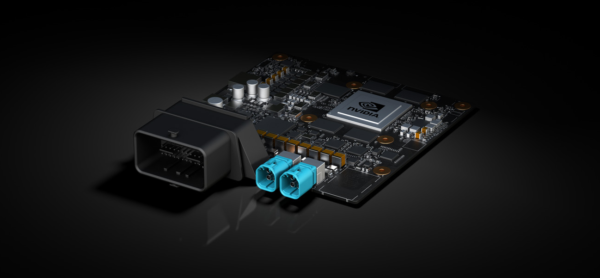
Nvidia’s involvement in automotive industry has just taken another positive step with the newly unveiled palm-sized, energy-efficient artificial intelligence (AI) computer which will allow automakers to power automated and autonomous vehicles for driving and mapping.
The new single-processor configuration of the Drive PX 2 AI computing platform for AutoCruise functions consumes just 10 watts of power and enables vehicles to use deep neural networks to process data from multiple cameras and sensors. It will be deployed by China’s Baidu as the in-vehicle car computer for its self-driving cloud-to-car system.
What is does is, a car using the small form-factor chip for AutoCruise can understand in real time what is happening around it, precisely locate itself on an HD map and plan a safe path forward. Currently more than 80 automakers, startups and research institutions are developing autonomous vehicle solutions using Nvidia’s Drive PX.
The new small form-factor will be the AI engine of the Baidu self-driving car. Last week at Baidu World, in Beijing, Nvidia and Baidu announced a partnership to deliver a selfdriving cloud-to-car system for Chinese automakers, as well as global brands. Data scientists who train their deep neural networks in the data centre on the Nvisia DGX-1 can then seamlessly run on the same chip inside the vehicle with the same algorithms, libraries and tools that run in the data center also run in the car.
Product Specifications
Nvidia Drive PX 2 is powered by the company’s newest system-on-a-chip, featuring a GPU based on the Pascal architecture. A single Parker system-on-chip (SoC) configuration can process inputs from multiple cameras, plus lidar, radar and ultrasonic sensors. It supports automotive inputs/outputs, including ethernet, CAN and Flexray. The new single-processor will be available to production partners in the fourth quarter of 2016.