
In the last few years, the mid-range smartphone segment has seen enormous growth and competition. Brands such as OnePlus, Xiaomi and Huawei had pioneered this market, and they paved the way for more affordable mobile phones that punch above their weight.
This had proven to be an uber successful approach as sales of these phones increased exponentially, while also allowing consumers to get more for every dollar paid. Before long, other manufacturers began to hop on the bandwagon; producing mid-tier phones at lower end prices. One such newcomer into the industry is Wiko, a French subsidiary of Chinese brand Tinno Mobile. Wiko has released several budget-oriented phones since its inception in 2011, and have recently launched the View3; a budget phone all set for 2019.
Design

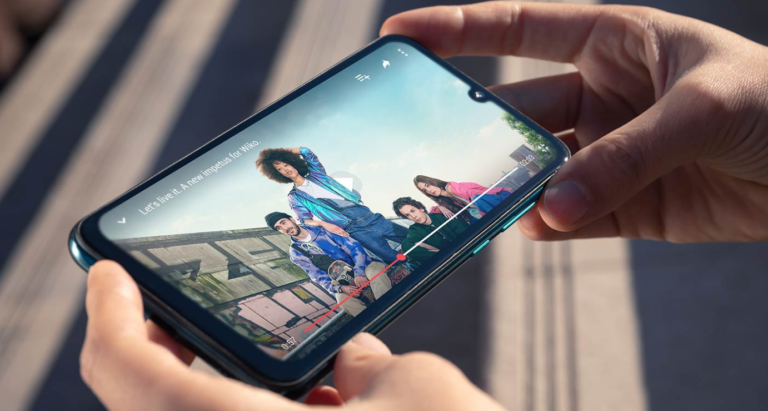
Like many other phones in 2019, the View3 has adopted the tear drop styled notch coupled with minimalistic side and top bezels. This not only gives it a more modern appearance, but it greatly enhances media consumption, albeit the slightly annoying protrusion which can interrupt an otherwise immersive media experience. Furthermore, Wiko has applied a slight colour gradient to the back cover of the View3, as is the trend in 2019.
The back cover is also flanked by a triple camera setup and a finger print sensor. Upon first look at the phone, you’d be greeted by a handsome looking 6.26” IPS display. With a resolution of 720p and a pixel density of 269 ppi, it isn’t the clearest display available on the market. In addition, its colour saturation and viewing angles aren’t the best either. However, this can be pardoned given the size of its bezels coupled with the adequately sized tear drop notch. Unfortunately, this notch is permanent, and cannot be hidden via software.
Internals
Powering the Wiko View3 is a Mediatek MT6762WB Helio P22 CPU which is an 8-core Cortex A53 processor with each core clocked at 2.0 GHz. The GPU of this phone is a PowerVR GE8320, which was more than sufficient for daily usage and even for casual gaming. During testing, I had even subjected this phone to Call of Duty, and it managed a playable frame-rate throughout a game of ‘Domination’. Having said that, it did only manage this on low settings, and by the second game, the phone started to heat up quite severely which resulted in intermittent lag. Furthermore, when it came to the ‘Battle Royale’ mode, it proved to be too much for the phone to handle.
A combination of data bandwidth and graphical power needed in this mode caused the phone to heat up just a few minutes into the game, which wasn’t the ideal gaming experience as my character kept dying due to the latency and lag.

The 3GB of RAM that is supplied with the View 3, and users will definitely be able to multitask to a certain extent with this phone. This is certainly attributed to the software running on it which is pretty much stock Android 9. Wiko has done an excellent job in keeping the operating system on it as stock as possible and without much bloatware and clutter in it, allowing for a higher amount of RAM allocation for other processes. Furthermore, following 2019 standards, 32GB of ROM is sufficient if you take its pricing into consideration. In the event of a lack of storage, it is always expendable to 256GB via an external miroSD card.
Wiko has included a built in 4000 mAh battery with the View 3. With normal usage, the phone is able to easily last a day. During the 1 week of testing, the day mostly ended with about 25% battery life left, after using it for an astonishing 7-8 hours. It is also possible to comfortably stretch a single charge over a period of 2 days without much worry.
The charging time of this battery is average for a unit of this size. Using the stock charger, it takes about 2 hours 30 minutes to charge the device from 0-100%. The View 3 does not recognize fast charging, so don’t expect blazing charge times.
Camera & Video

Undoubtedly, the highlight of this phone is the awesome rear triple camera setup. As seen, it does come with a dedicated 2MP bokeh lens, meaning that the bokeh effect is done via hardware, rather than software. However, it is a bit lot a let-down, as it does not map the outline of the subject very well. Personally, the highlight of the View3 is the 13MP super wide-angle lens.
With a 120◦ field of view, so much more of the surroundings can be captured in the picture, resulting in photos with a sense of depth and immersion which simply cannot be reproduced by software, or even a regularly angled lens. Having a super wide-angle lens in a phone at price point is beyond amazing, and more manufacturers should adopt this practice. The third rear lens is the dedicated 12MP low light lens. Don’t expect Huawei P30 night mode, but it certainly results in a noticeably lower amount of noise, more detail, and generally a photo that is more pleasant to the eye.
Video from the rear camera is of average quality, with a maximum of 1080p recording. In addition, there is also slow motion and time lapse for some creative shots. Users will also be graced with Google Lens, which is useful at times, albeit a little buggy.





The front camera of the View 3 consists of an 8MP shooter, and is assisted with AI functions. Like the rear camera, the front shooters are able to capture vivid photos with the right amount of light. One specific scenario where it breaks down is when there is a certain amount of light behind a subject. The result is an overexposed background, with a relatively soft subject detail. Furthermore, the edge detection using the portrait mode on the selfie camera is a bit of a disappointment, as the camera constantly struggles to accurately map out subjects.
Final Thoughts
Given the current saturated mid-range market, manufacturers need to have a differentiating factor between their phones and other phones. Like existing competitors in 2019, the View 3 checks all the boxes; 3.5 mm headphone jack, tear-drop notch, and thin bezels. However, if there is one feature that ultimately puts the View3 ahead of competitors within the same price range, it will have to be that gorgeous wide-angle camera. For the average social media posts, you’ll be able to leverage this camera to get some creative and captivating shots. Given the RM599 price tag, you’ll need significant justification to rule it out of your choice of phones.