If you’re reading this in Russia for the World Cup, I envy you. What I don’t envy however is your increased risk of being hacked. Kaspersky’s latest research shows that 7,176 of the 32,000 public Wi-Fi networks in World Cup host cities don’t use traffic encryption. This makes them potentially unsafe for use by fans visiting the cities.

Kaspersky’s findings are based on an analysis of public Wi-Fi spots in 11 FIFA World Cup 2018 host cities. This includes Saransk, Samara, Nizhny Novgorod, Kazan, Volgograd, Moscow, Ekaterinburg, Sochi, Rostov, Kaliningrad, and Saint Petersburg. Their results show that plenty of access points have encryption and authentication algorithms; these are aspects that are essential for Wi-Fi networks to remain secure. However, plenty of connections remain suspect and potentially dangerous for use.
The cities with the highest percentage of unreliable Wi-Fi networks are Saint Petersburg (37%), Kaliningrad (35%), and Rostov (32%). In contrast, the safest places were relatively small towns – including Saransk (only 10% of Wi-Fi spots are open), and Samara (17% of Wi-Fi spots are open). Almost two-thirds of all public Wi-Fi networks in these locations use the Wi-Fi Protected Access (WPA/WPA2) protocol family for traffic encryption. These are protocols that many consider to be one of the most secure for Wi-Fi use. Of course, determined hackers can still brute-force their way through these networks. You can see a breakdown of the types of Wi-Fi encryptions in the host cities below:
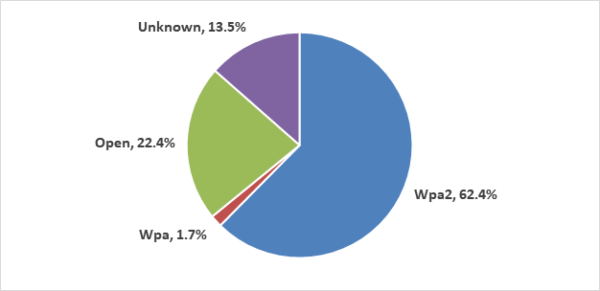
“The lack of traffic encryption, coupled with large-scale events – like the FIFA World Cup – make wireless Wi-Fi networks a target for criminals who want easy access to user data. Despite about two-thirds of all access points in FIFA World Cup host cities using encryption based on the most secure Wi-Fi Protected Access (WPA/WPA2) protocol family, even these access points can’t be considered secure if the password is visible to everyone. Our research shows, once again, that cybersecurity involves addressing not just certain aspects, but the entire infrastructure. FIFA World Cup 2018 has confirmed that the event itself is secure – but users should be aware that clearly its host cities’ public Wi-Fi hotspots are often not,” says Denis Legezo, Senior Security Researcher at Kaspersky Lab.
You can still stay connected while watching football in Russia no problem. All you have to do is ensure you follow a simple guideline to help protect your personal data:
- You should always use a VPN whenever possible. This ensures you encrypt your internet traffic, ensuring no one can read it even if they access it.
- You should never trust networks that aren’t password protected. The same applies for networks with easily found passwords, such as cafes or bars.
- When possible, you should turn off Wi-Fi connections when not in use. You also increase your battery lifespan by doing so.
- You shouldn’t share too much personal data if you’re unsure about your Wi-FI security. This means you should just limit to basic web surfing. Furthermore, you should avoid entering login details and banking data when using public internet.
- Enable ‘always use secure connection’ (HTTPS) in your devices. You should always have this on when visiting websites lacking necessary protection.
For more information about the Wi-Fi network situation in the World Cup host cities, you can click here.