




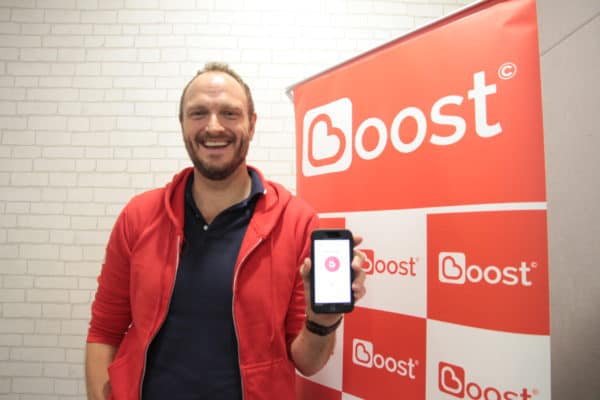
Boost has come a long way since its inception in January 2017. Although it is still relatively new into the market, Boost CEO Christopher Tiffin believes that it will succeed, and he has every right to do so.
We sat down with Christopher to poke his brain on what Boost is all about, what makes it tick and how far it can go to turning Malaysia into a cashless society.
PC.com: Could you share a bit more about the Boost app, how it came about and of course, what made Axiata move into this space?
Christopher Tiffin: Actually, Axiata has been in mobile money for a long time. Celcom has had a mobile money license for the past few years now, which we got from Bank Negara. If you look across the footprint, we have got mobile money services in every market. But, the reality is, the game’s changing.
In every market, it’s a different brand, different product and different technology. There’s no synergy and it’s all developed in markets under the telco operations. However, in the past five years, the telcos are changing. There’s a lot of competition and a lot of digital services coming in.
The digital evolution curve is really accelerating so as a group, we decided to have Boost as a standalone independent and agnostic operation. We did an assessment on how best to do that and the decision was that we should have the setting outside of the traditional operation as a separate structure. With that, we take it from just being mobile money to digital financial services. In a separate vertical, this allows us the opportunity a) to be a different brand; b) it allows us to be agnostic, where we’re given the freedom of choice of working with many industries.
Since 2017, we have been operating independently. But, the key thing I want to say is that we do want to be seen more than just a wallet. It is more of a lifestyle with the interaction and experience that we offer you is more than just function, with a little bit of an emotional attachment.
PC.com: With that said, it leaves me to my next question. You’re coming into the market at a time where there are already a couple of other players out there and even telcos are getting into the action while mostly dedicated to their own subscribers. What makes potential users to feel compelled to use Boost?
Christopher: I think that is the million-dollar question. But, there are many factors to consider. Firstly, how can we be better than cash? The reason we’re doing this is not because we just want to make a business out of it; we want to address a need. And the need is starting from digital economy, which is a huge factor in Malaysia. Then, a portion of that is also financial inclusion and through that is where the digital economy is a growth factor.
But, financial inclusion is where it starts getting better than cash. That’s the premise of where we’re working from. We don’t want to compete with banks or credit cards, we want to work with them to develop the ecosystem so that we can become the fintech arm to deliver what banks are not able to deliver today to replace cash.
In the digital world, the ‘ego-system’ needs to grow and change to become an ecosystem. The days of owning everything and doing everything yourself is gone; partnership and collaboration is key along with education.
On the topic of how we’re going to get people to use Boost, the first step is understanding. Education and understanding needs to be done, and not just for consumers, but also for partners and merchants for them to see this as a form of replacing cash.
Through the combination of those areas, there’s no one element that will make it, there’s no silver bullet. It is an ecosystem development that needs to happen, it must be done jointly and yes, there are plenty of others coming in. The reason being is because it’s a huge opportunity. There is no such thing as competition; our biggest competitors are ourselves. We are our own biggest hurdle. Competitors should be ecosystem development partners and that is where we should be heading.
In saying that, in Malaysia, there are around 26 licenses for e-wallets. While not many are currently launched and operating and we would assume to see more doing so in 2018, however is this sustainable? Most probably not. Is it going to lead to a possible scenario of consolidation? I think there would have to be. Otherwise, the education part becomes confusing, not just for consumers but also for the market. It’s a process. At the moment, how do we see ourselves being different? One of the key elements is that we do have – not just in Malaysia but in the region of Southeast Asia – access to 350 million customers across the footprint. Another key aspect is that we also got access to a lot of data.
PC.com: And how would you convince a new user into using Boost and adopting a cashless society?
Christopher: To be fair, that is the hardest nut to crack. The change of behaviour is the key fundamental to making all this work. But, what we’ve seen through technology, it has rapidly progressed over the past 10 years. Back then, we didn’t have iPhones and now, we can’t live without them. If you look at the evolution over the last five years, it’s double of what we’ve had in the first five years.
It has taken 10 years from being told what we think you want to be in control of oneself. That journey takes time but it’s the change of behaviour that is the fundamental thing that will drive it.
But the reality is, it’s also a ripple effect of what happened. If we look at the young digital adults and the older generation, you will find that the adoption rate in certain age groups are a lot quicker. This is because of the usability of it, the convenience as well as the ability for them to bring others into the ecosystem.
There is absolutely no way you can get everyone adopted from day one. It is going to take time, but this is where the relevance of what we’re doing and providing through Boost as a product needs to be more important instead of just the functional aspect of it. It needs to be simple, convenient, secure, affordable and most importantly, fulfils a need.



One Response