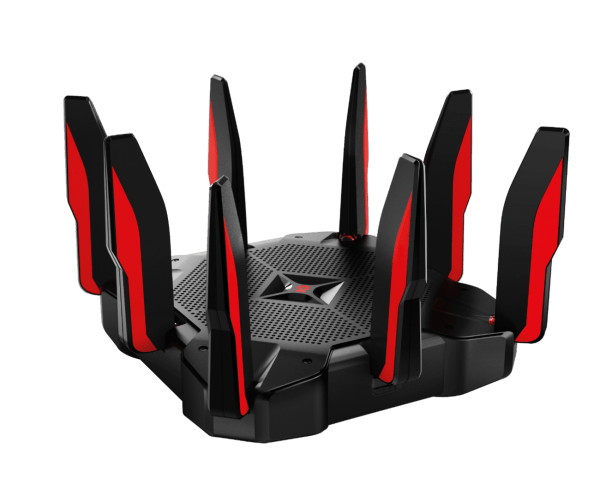
While its essential to have high speed broadband at home to enjoy the vast availability of rich content in the net, its also just as important the various equipment installed to broadcast the signal throughout the home is attended to. Depending solely on UniFi or TIME’s service to your abode to give that experience you’re looking for does not cut it. You also need a reliable router!
TP Link has been making this spaceship looking device that help spread out your broadband signal for decades and have mastered the science in network management. Not sitting on its laurels, the company has just released another thrilling at MWC, the AC5400 Tri-Band Wi-Fi Router Archer C5400X, the world’s first 1.8GHz 64-bit quad-core router.
Made to take on the modern day tasks and prepared for the demands smart home networkingm the router is even designed to handle — video conferencing, live gaming, 4K streaming. At the heart of Archer C5400X is a 1.8GHz 64-bit quad-core processor with a low-powered 28nm Broadcom Cortex-A53 chips to coordinate every process and reduce transmission delay.
Transfer Speed
The new processor give the equipment transmition speeds with three separate wireless bands for combined speeds of up to 5334Mbps: 1000Mbps 2.4GHz band for surfing, online shopping and audio streaming, and two 2167Mbps 5GHz bands for 4K streaming and gaming. A 4×4 MU-MIMO serves devices 4x faster than typical AC routers, while NitroQAM™ increases maximum Wi-Fi speeds on all bands by 25%. RangeBoost is a new technology that increases the router’s signal sensitivity, helping faraway or weaker devices connect. Together, these technologies create large, stable and fast Wi-Fi for multiple devices at once. It also has a 16GB storage, 8 Gigabit ports that delivers up to 1000Mbps for IP cameras, desktops, game consoles and TV boxes for entertainment speeds.
By the looks of it, there is just one router that can be better than the newly launched Archer C5400x and its currently being developed in the labs of TP Link!