The Malaysia Digital Economy Corporation (MDEC) continues its collaboration with Alibaba, specifically Alibaba Cloud; through the signing, both have introduced the Malaysia City Brain initiative. This concept is one of the core foundations that sets in the cornerstone for the National Artificial Intelligence (AI) Framework. This is one of the critical growth factors that Prime Minister Dato’ Sri Mohd Najib hinted at during Budget 2018.
When properly deployed, the Malaysia City Brain will offer acquisition and integration of big and heterogeneous data analytics. It will track and study the various information that folks are generating within these multiple urban spaces. This includes the use of video and image recognition and data mining processes; both will use machine learning technologies that Alibaba Cloud put together.
As is, the Malaysia City Brain marks the first time it’s in full deployment outside of China.
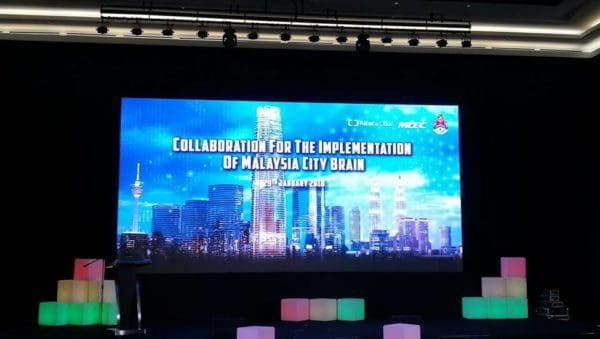
The first phase of the programme will be oversee traffic management and improve mobility within Kuala Lumpur (KL). According to MDEC, the Malaysia City Brain will initially undergo an implementation pilot and focus on KL’s Inner Ring Road. Once the tests are complete and fully understood, the entire concept will fully roll-out into the whole of KL. It is will become operational by May 2018. MDEC CEO, Datuk Yasmin Mahmood, reveals the end-goal is to have the private sector take the lead for this initiative.
Starting with 382 camera feeds and 281 traffic light junctions, the system will operate just like the HangZhou City Brain. Of course, this includes tapping onto the massive computing-engine used in the Xiaoshan district for the city of Hang Zhou, China.
Leveraging Alibaba’s Cloud Computing and data processing capabilities, the Malaysia City Brain will fully optimise the flow of vehicles. By learning and calculating the time to reach intersections, it can determine what would work best for traffic operations. It will also generate structured summaries of data, such as traffic volume and speed according to lanes. This means being able to place more resources on other tasks, such as incidence detection or assisting emergency services.
The Malaysia City Brain is, technically, a proof of concept that came to be on August 2017. It is the result of a collaboration with the ASEAN Data Analytics Exchange. Just like the HangZhou City Brain, the entire platform runs on an open platform. Hence, businesses – like start-ups, entrepreneurs, or educational and research institutions – will be able to leverage on the data as well. Having such access will allow them to engage the necessary materials that they have on-hand to work with AI tools. In doing so, they will be able to further push innovation processes to the next level.

In line with the initiative to develop the National AI Framework, Alibaba Cloud will also introduce the Malaysia Tianchi Big Data Program. It will act as a Big Data crowd intelligence platform that brings together global data experts who can collaborate and compete to develop solutions for real world problems.
The Malaysia Tianchi Big Data Program will be integrated into Alibaba Cloud’s Tianchi global community. This will expand the operational base of 120,000 developers and 2,700 academic institutes and businesses from 77 countries and regions. With the backing from MDEC, this initiative aims to incubate 500 data professionals and 300 start-ups in Malaysia within the next two years.