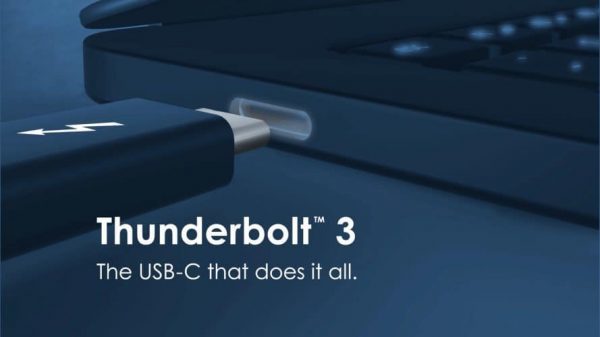
Intel is really pushing it forward for Thunderbolt, and is aiming to integrate Thunderbolt 3 into future Intel CPUs and by releasing the Thunderbolt protocol specification to the industry next year – essentially putting it everywhere you can think of (in electronics).
While Thunderbolt is adopted into the specs of many higher end and flagship products, this push hopes to drive large-scale mainstream adoption. With Thunderbolt, all the ports on a computer can be the same – any port can charge the system and connect to Thunderbolt devices, every display and billions of USB devices. With the integration into CPU, computers can be built thinner and lighter. It uses less board space and reduces power usage as well.
Intel will also make the Thunderbolt protocol specification available to the industry under a nonexclusive, royalty-free license. Releasing the Thunderbolt protocol specification in this manner is expected to greatly increase Thunderbolt adoption by encouraging third-party chip makers to build Thunderbolt-compatible chips.
It’s not that far fetch an idea though. Already there’s an increase in adoption for USB-C, and with the demand for photos and 4K video, lifelike VR, and faster-than-ever storage, a high performance single-cable dock will be needed to fulfil these demands.
Apple has adopted Thunderbolt since conception, while Microsoft enhanced Thunderbolt 3 device plug-and-play support in the now available Windows 10 Creators Update.
“Microsoft and Intel are working together to enable Thunderbolt 3 on Windows PCs to deliver on the ‘if it fits, it works’ potential of USB-C,” said Roanne Sones, general manager, Strategy and Ecosystem for Windows and Devices at Microsoft.
In addition to support from Apple and Microsoft, Thunderbolt 3 has already gained significant adoption with more than 120 PC designs on systems with 7th Generation Intel Core processors, the latest MacBook Pros and dozens of peripherals – expected to ramp to nearly 150 by the end of 2017.