It’s no secret that Wikipedia has been subjected to government censorship in several countries. Turkey blocked articles related to female genitals; Russia pretends that weed doesn’t exist; UK decides that German metal bands are not worthy of knowing; and the biggest censor happy country (at least in countries with occasional access to Wikipedia) is China – where the entire site has been banned on several occasions.
The Wikimedia Foundation has long been trying to prevent such censorship, and researchers from Harvard Center for Internet and Society has found a solution – encryption.
Wikipedia added support for Hyper Text Transfer Protocol Secure (HTTPS) in 2011. Both HTTP and HTTPS are used to transfer data from a website’s server to the browser on your computer, but when connecting using HTTPS, your browser will first ask the web server to identify itself. The server will send its unique public key which is used by the browser to create and encrypt a session key. This session key is then sent back to the server which it decrypts with its private key. Now all data sent between the browser and server is encrypted for the remainder of the session.
In a nutshell, HTTPS prevents governments and others from seeing the specific page users are visiting. For example, a government could tell that a user is browsing Wikipedia, but couldn’t tell that the user is specifically reading the page about Tiananmen Square.
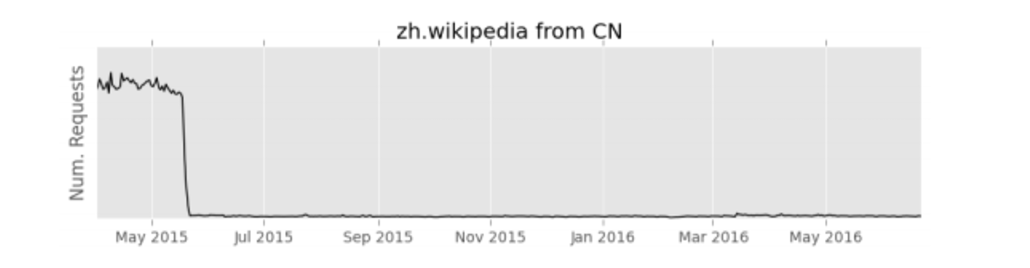
The researchers saw a sharp drop in traffic to the Chinese language Wikipedia around May 19, 2015, indicating a censorship event. Turns out, the site had been blocked in anticipation of the upcoming anniversary of the Tiananmen Square massacre.
Up till 2015, Wikipedia offered their service on both protocols – so while countries could block HTTP version of Wikipedia, the full version is still accessible through HTTPS. In june that year, Wikipedia decided to kill HTTP access and only offer it on HTTPS – so governments can no longer censor individual articles, forcing governments into a all or nothing deal.
While some thought this will end up in more total censorship of Wikipedia, new research from Harvard shows that full encryption actually result in a decrease in censorship incidents around the world.
Although countries like China, Thailand and Uzbekistan were still censoring part or all of Wikipedia by the time the researchers wrapped up their study, they remained optimistic: “this initial data suggests the decision to shift to HTTPS has been a good one in terms of ensuring accessibility to knowledge.”