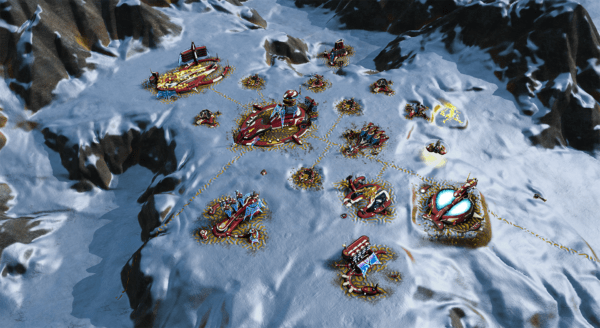
Stardock’s latest space-flung sci-fi adventure, Ashes of the Singularity is one of those games that remind us what the word ‘strategy’ is supposed to mean. Its large scope, healthy disdain for micromanagement, and strong emphasis on high-level thinking is refreshing. While it does not quite pack the punch of Supreme Commander: Forged Alliance, it does hit the mark in several of the same places.
Putting the S back in RTS
The single-player campaign is set in a future where the Post-Human Coalition sends robot armies out to do battle with other robot armies of mysterious and aggressive AI called The Substrate. There are eight main missions and three optional ones. Most of the 11 missions feel more like an extended tutorial compared to the interesting multiplayer challenges.
The two races, Post-Humans and Substrate don’t play significantly differently. Post-Humans get tougher hulls and more self-sufficient basic units, while Substrate have rechargeable shields and a bit more mobility. Given the high-level focus on strategy, you will always be emphasising which tools to bring over who has the better toolbox. Thinking back over a match, I often realise that one side or the other had already clinched victory long before the last base well.
Think big
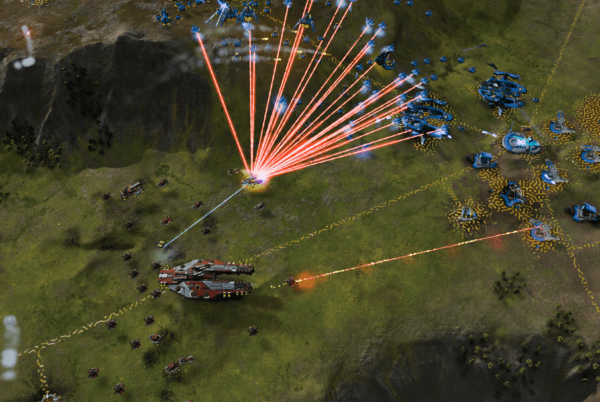
You have to think of the awe-inspiring scale of the battles and the armies fighting over them. The number of units can easily go up to 100 by the late game. There are squads of small, frontline tanks, mid-sized cruisers with versatile battlefields roles, massive dreadnoughts with the ability to level up and hold their own against hordes of smaller vehicles. The creative and distinctive unit designs are fun to look at and allow you to easily assess the composition of an army at a glance. Especially dreadnoughts, which become distinctive characters as they level up, with each hull speaking to the theme and capabilities of the hulking capital ship.
The game engine handles it all incredibly well too, with no notable slowdown on my Core i5, GeForce GTX 970 on Windows 10 even when the battlespace gets very crowded. A flexible and responsive zooming camera makes me feel like I was managing an entire theatre with multiple, full-scale battles going on across the colossal maps.
Ground control
Ashes allow control of large groups of units grouped into formal armies with the press of a hotkey, which will adopt and maintain a logical formation and act effectively as a single entity. This creates interesting ultimately rewarding learning curve.
Commanders compete for resource nodes spread across the map with only node connected by a chain to your base generating resources that creates opportunity to crash the entire economy by surgically taking out a key node in a smaller, more agile force before a larger, dreadnought-anchored armies can respond. Options for rapid, reactive counters are few, and have a high resource cost.
My only significant gripe was the bland environment art. Unadorned, repeating slopes of brown and green stand in contrast to the creativity and distinctiveness of the units. Adding more of this visual detail and personality to the maps themselves would have gone a long way.
Final thought
Once you break free from the speed and tactics-focused mindset of most RTS, Ashes of the Singularity is a challenging cerebral exercise that has me mentally iterating on army compositions, build timings and board deployment schemes even when I am not playing it. Aside from the weak campaign, Oxide has delivered on the promise of bringing capital-S Strategy back to the RTS space.
Developers: Oxide Games
Publisher: Stardock
Platforms: Windows
Release Date: 1 April 2016
Genre: Real-time Strategy
Players: Single-player, Multiplayer
Reviewed: Windows
Score: 8/10