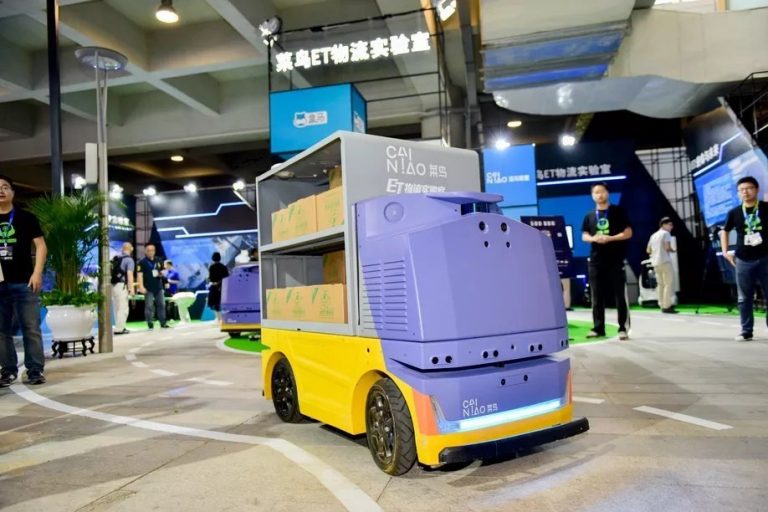
The world of robotics just gets more interesting. Alibaba Group’s Cainiao Network and RoboSense partner to release G Plus, the world’s first unmanned logistics vehicle. It uses solid-state light detection and ranging (LiDAR) technology developed by China’s RoboSense. Interestingly, this is the first time solid-state LiDAR has been used in a driverless vehicle.
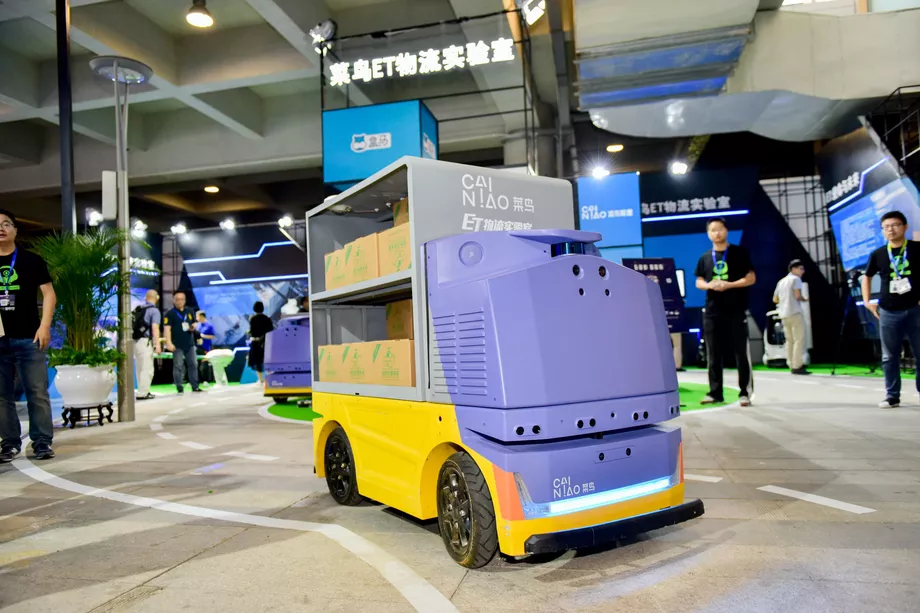
Mass production of these vehicles serve to streamline mass market deliveries. These unmanned cars also equip different smart devices to act as either courier vehicles, mobile coffee carts, or whichever is in demand.
Alibaba’s Cainiao G Plus comes with three RS-LiDAR-M1Pre sensors, two in the front and one in the rear. The sensors use 3D perception to manage the vehicle’s driving. This includes detecting shape, distance, travel speed, as well as pedestrians, cars, and other obstacles.
The RS-LiDAR-M1Pre uses a micro mirror scanning scheme. The resolution it scans at reaches 0.2 degrees throughout the angle of view. This means it uses only few laser emitters and receivers to scan compared to traditional multi-beam radars, hence saving cost. In comparison, mechanical multi-beam LiDAR requires more than a hundred laser transmitters for the same effect.
“The solid-state laser has the advantages of high stability, high resolution, and low cost, and it can well meet the demand for OEMs,” says Mark Qiu, co-founder and COO of RoboSense. “Alibaba and RoboSense both agree with this direction and we hope to increase our strengths jointly to promote mass production of unmanned logistics vehicles.”
Alibaba’s Cainiao Network Technology Logistics Laboratory also announces a plan named “Hump Project.” It joins a number of companies, including FAW Jiefang, Beihang University’s Drone Team, RoboSense, and Dian Wo Da, to mass produce unmanned equipment. These equipment consist of a three-dimensional intelligent logistics network for unmanned vehicles and drones.