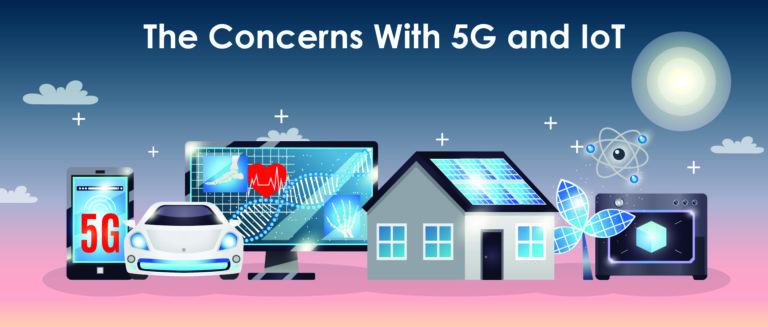
 5G might be the hottest thing on the market right now, and connectivity as well as the Internet of Things (IoT). 5G has high data speeds, low latency, more flexibility, low energy consumption, cost-effectiveness and ability to withstand a far greater number of devices. Everyday objects such as light-bulbs and city assets are linked to the internet, not just phones, computers and tablets. But where there is progress, there will be issues as well, and therefore we’re here to discuss potential downsides to having everything connected with 5G.
The security concerns of 5G with relation to financial data is also of concern. Financial institutions such as banks store thousands if not millions of customers’ data in their servers. With 5G, the data is more likely to be stored in a cloud based computing system. The security of the data in the cloud is questionable. Although the technology is not new, the cloud is susceptible to hacking and is vulnerable to attacks.
Even in the 4G era, customers face security concerns with mobile banking apps among other online banking security issues.
How do authorities work with Internet providers to give users a safe environment? There are government agencies like Malaysian Communications and Multimedia Commission that oversee what happens in the country when it comes to Internet and related issues. But is that enough to make sure all things go smoothly?
To help us better understand exactly what the downsides of 5G could be, we reached out to Cybersecurity Malaysia help better explain it.
“The power and potential of 5G goes way beyond enabling super-fast video streaming with zero lag time and full-length movie downloads within seconds. The new 5G technology will provide more stable mobile network for these activities and will also enable infrastructure for other services,” said YBhg. Dato’ Ts Dr Haji Amirudin Abdul Wahab, CEO of CyberSecurity Malaysia.
“However, the technology and increased use of these devices will enhance vulnerability and possible security threats. For example, in the healthcare industry, 5G will enable the transfer of large patient files, remote surgery and remote patient monitoring via IoT devices more efficient and faster. But those advances required the need for ever-stronger security. Creating risks that include medical identity theft, invasion of health privacy, and medical data management.” he added.

1. Vulnerability to Cyber Attacks as a result of Mass Connectivity –
5G will bring about change in many different ways. But whether the change is ultimately positive or negative, remains to be seen. With Internet of Things (IoT) and mass connectivity, there will be plenty of new devices that are vulnerable, if not properly protected. Wearables, cameras, TVs, Printers, and even lights are already able to be controlled by your phone. With 5G, it just makes even more things connected. So practically, only one device has to be compromised, and you could practically control each and every other connected device.
Are there solutions being developed in this case?
If a smart device is hacked/accessed would it be able to access everything you have because of that one infected data stream? To answer this we take to YBhg. Dato’ Ts Dr Haji Amirudin Abdul Wahab, CEO of CyberSecurity Malaysia to better understand what we can expect.
“As 5G makes high-speed internet increasingly available, the number of devices in the network will increase dramatically. The larger the network, the more opportunities there are for hackers to attack, meaning there is an increasingly complex system with more parts that need protecting,” he said.
“The 5G technology lies underneath has changed how it works compared to 4G. For example, because 5G networks can be sliced into uniquely purposed slices, each virtual network slice demands unique security capabilities based on the needs of different usage scenarios (5G network slicing allows operators to split a single physical network into multiple virtual networks in order to offer optimal support for different types of services for different types of customer segments.)”
So there are considerations to take into account, and not for us to only be totally hyped about the super fast downloads and such. Our data could be even more vulnerable, especially in a world where everything’s connected. Not unusual, but it doesn’t seem to be something people are taking into account.
2. Smart and Self Driving cars – Prone to being hacked?
Smart cars and Self driving cars are more and more looking to be a viable, possible option. Tesla has implemented probably, the most accurate and feasible way of self driving cars to date. We are at an increasingly fast pace, headed to a world of autonomous vehicles and driving. While it does sound alluring, having not having to drive anymore, there are obvious concerns when it comes to Self driving cars. While it may look like Tesla has got it all figured out, they did have issues where their self driving cars were getting into accidents. Some of these accidents resulted in people losing their lives.
With autonomous cars, there is a responsibility and things to be taken into account before fully being implemented across the world. One of the top concerns when it comes to autonomous cars has to be stripped down to human error. The biggest factor has to be human interference, and doing something that an autonomous vehicle would not expect. With the implementation of 5G, we can expect cars to also start having their own auto-pilot mode because of the super low-latency speeds of the network. They could possibly follow a GPS, or even connected to Waze or Google maps to find the faster routes. Or even having cars connected to traffic lights, and when there’s a certain number of cars, the light turns green.
The possibilities are endless, but so is the downfall. To have such a system be in place, everyone has to use it, otherwise the point is moot.

At the moment, the world isn’t ready to fully embrace the capabilities of autonomous vehicles. Keeping IoT in mind and everything being connected, your car could be one of the first things TO be hacked. In a world where all cars are connected via 5G, they’re even more susceptible to being broken into. A person would just need to hack into the network connecting all these cars on the road, and havoc would ensue. Certain measures have to be put into place, before autonomous cars and driving becomes the norm. What these measures are exactly, are still to be seen.
3. Privacy issues of 5G –
Whether you like it or not, being connected is integral in everyone’s life so you are susceptible to the issues concerning 4G and soon, 5G. The privacy issues of 5G include loss of information, hacking of data, identity theft among others. Everyone has a bank account and nowadays e-banking is very common. Financial institutions like banks have to be very careful with customer data. When money is concerned, encryption is needed to prevent theft. Before this in the past, banks get robbed and everything happens in real life. Nowadays, cyber-crime takes less effort but the repercussions are the same.
With the advent of 5G in an ever evolving technological world, location data is about to become extremely valuable.
Professor and former researcher at Bells Labs and AT&T Labs Research Steve Bellovin had an interview with The Wall Street Journal. During the interview, he talks about privacy and location concerns. These are his thoughts on the matter of 5G and Privacy.
With our 4G network now, we’re capable of pinpointing to where you are on a map, to a point. But with 5G, it’s a whole other game considering how accurate it would be. 5G signals have shorter ranges in comparison to 4G, and therefore wouldn’t go as easily go through buildings. And with that, more cell towers will probably be popping up. These cell towers could be placed in new places, particularly indoors like in malls, university campuses, and public spaces. Probably even near your homes, or on apartment buildings. With new cell towers popping up, these signals will have to cover smaller distances. Therefore they will be able to accurately pinpoint you to an exact point.
Another thing to take into account, is that Huawei is a major player in 5G equipment manufacturing right now. With reports criticising and questioning if Huawei has links with the Chinese government, we have to speculate on the possibility. Bellovin mentions that “If the Huawei gear is backdoored then they can collect metadata and relay unencrypted traffic.” And that in and of it self, is concerning enough. Your data being proccessed who knows where by who knows who. And the fact that your location could be compromised to an exact point, is something scary to imagine.
However, with the proper, full implementation worldwide still years away, we might not have to worry about this yet. It’s good to remember that 5G isn’t only going to be a boon for all of us, but can also bring us to ruin.