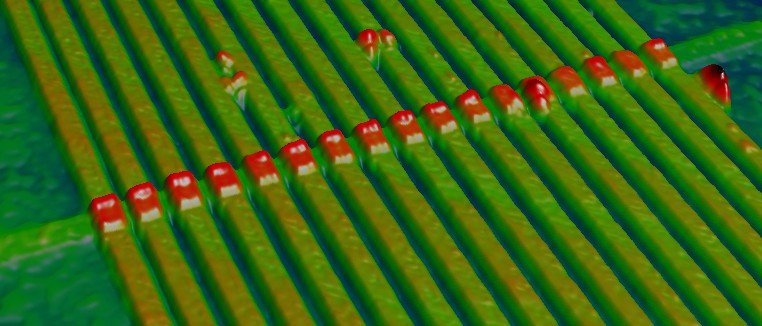
System boot up no longer needed…Welcome to the world of The Memristor, the future of the personal computer. Could you ever imagine a day when you turn on the computer and you don’t have to boot it up to use it. Instead, it turns on instantly, just like how you turn on your computer monitor when its off. Well that day is here, Hewlett Packard and a team of scientists in Switzerland have successfully developed The Memristor.
The Memristor is the fourth element for the electrical circuit. It is a new form of resistor with a memory that will replace the transistor. What it does it that it stores electrical energy even when its turned off. It remembers the electrical current that flowed through it while it was on. So it doesn’t require heating up for it to operate, instead it’s already operating even when it’s off. This is because its power is no longer limited to the 0s and 1s of electrical technology, the memristor can allow the computer to operate in between the 0s and 1s, or equivalent to the on and off of the electrical circuit, allowing more processing room which in turn can create a higher speed computer.
The memristor was first conceptualized by a physicist in 1971 to be the fourth element in the electrical circuit, alongside the resistor, the capacitor and the inductor. It took 37 years before the actual memristor is developed. A breakthrough in scientific innovations for computers.
The D-RAM, dynamic random access memory, in computers would soon be replaced by the memristor as its ram. The problem with the D-RAM today is that it requires sometime to heat up for it to operate and to release the information that was stored in it prior to its shutdown.
Current computer technology consumes a lot of energy to get the data from the power point, into the motherboard, to the hard disk and then to be processed. About 70% of heat energy is used for this operation and only 30% of it is used to process the data itself.
With the memristor in place, the hard disk, the chips and the central processing unit could be combined into one, allowing super fast processing for the computer.
The memristor is as tiny as nanotechnology itself, a lot of smaller and thinner than the computer chip. The computer chip no longer has space to be packed on with more tiny material, it has reached the limit of miniaturization.