The ASUS FonePad 7 has been reviewed before in our labs but Intel feels it needs a return visit as it now comes packing with an Intel System-on-Chip (SoC) processor, specifically the dual-core Intel Atom Z2560. Since the core of the FonePad 7 has changed, it is also appropriate to re-label the model number with a variant count, hence the new ME372CG numbering. With the new CPU and same innards as its older Intel powered brother, how does it truly fare?
Nice Build
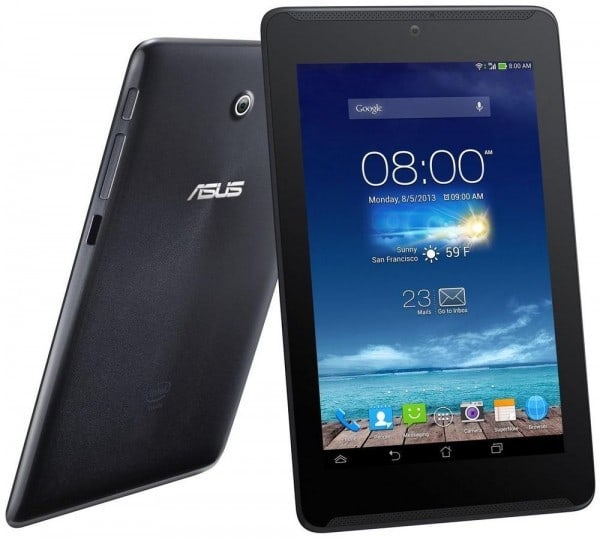
Out of the box, the new FonePad 7 looks and feel like the original model. The key difference here is the sleek plastic used throughout the chassis, which gives it a nice look and feel. Not as premium as the previous FonePad but at least the chassis feels uniformed now with both front and back using the same hardened plastic material. I like how ASUS listened to its users and moved the speakers to the front-plate and made it stereo even. This gives a little more class to the overall feel of the new FonePad 7.
Power Performer
For all intents and purposes, the new FonePad 7 is meant to be a mid-range device that fills in the gap for those who cannot afford the pricier Google Nexus 7. That would mean it shouldn’t perform just as well as that flagship device. However, when I played graphic intensive games as well as Full HD movies on the FonePad 7, everything came out buttery smooth. Thanks to the new Intel Atom CPU within, the laggy user experience I had been expecting is nowhere to be found.
Vivid Visuals
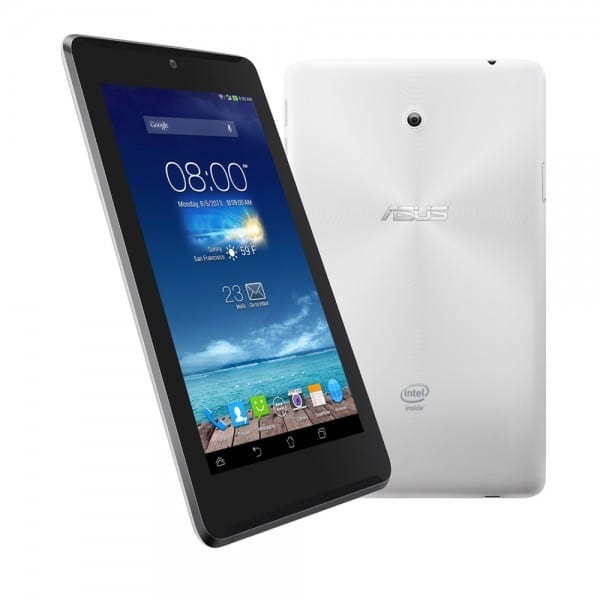
It is a good thing the FonePad 7 carried forward the awesome display performance of its predecessor as that is one of the more renowned features of the previous FonePad. For this new iteration, colours great while image processing had no faults in picture clarity and screen refreshes. I personally like how everything ‘fit’ nicely on the 7in screen with no wastage of space where app/widgets can clutter.
Long Chug
Since the new FonePad 7 uses an Intel Atom chip, it is safe to say that the battery life for this mini-tablet is phenomenal. On standby with minimal use, it lasted for 3 days before needing a full recharge. With massive usage, the 3950mAh battery lasted around 20 hours before it puttered out and needed to be plugged to a charger. Impressive battery life indeed.
Dimensions (W x D x H): 120 x 196.8 x 10.5mm
Weight: 328g
Display: 7in LED Backlight WXGA (1280 x 800) IPS Panel with 10-Finger Multi-Touch Support
CPU: Intel Atom Z2560 1.6GHz Dual-Core CPU
Memory: 1GB RAM
Storage: 16GB (starting from 8GB, up to 32GB)
Network: GSM/EDGE, WCDMA/HSPA+
Connectivity: WiFi 802.11 (a/b/g/n), Bluetooth V3.0
I/O Ports: 1x Micro-USB, 1x 2-in-1 Audio Jack (Headphone/Mic), 1x microSD (with 64GB support)
SIM: Micro SIM
Camera: 5MP (Main) with Autofocus and 1080p recording, 1.2MP (front) with 720p recording
Battery: 3950mAh Li-Ion
Antutu: 17,150
3DMark IceStorm Standard: 6,630
3DMark IceStorm Extreme: 3,658
3DMark IceStorm Unlimited: 6,202
Value: 8/10
Features: 10/10
Performance: 10/10
Design: 10/10
Usability: 10/10
Verdict: Powerful, yet affordable.
Total Score: 9.6/10
This review was written by Victor Yap, and can be found in the January 2014 issue of PC.com.