There is no denying that the way we consumer multimedia and entertainment has evolved over the last decade. We have moved away from being “desktop-based” to going mobile – a trend that isn’t likely to stop given the increase number of mobile devices and broadband connectivity made available in the market today.
The telecommunications industry continues to be fast-paced; growing and changing with the needs of its consumers, especially those in the Mobile Network Operators (MNOs) space.

Malaysia’s mobile penetration has also reached over 140% since 2014, with 8.9 million smartphone users. According to Statista, by 2016, the number of smartphone users in Malaysia is estimated to reach 11 million, with the penetration rate to remain the same.
Frost & Sullivan adds that growth in the non-voice revenues is supported by increase in the smartphone penetration, and attractive data plans and bundled offers.

The numbers are further supported by tech industry giant Ericsson, in its Ericsson Mobility Report 2015. Todd Ashton, Head of Malaysia and Sri Lanka, Ericsson, shares that Malaysia’ smartphone subscription penetration is higher than its urbanisation rate last year. It is expected to further grow in the next three years.
The growth is driven by the increase in data usage, which will delivers an array for opportunities for MNOs, and will continue to do so in the coming years.
Steady Outlook
Given the positive outlook in the sector, it is no wonder MNOs are now using innovative marketing tactics to attract new subscribers, while trying to retain existing ones. With the increasing adoption of social media, achieving this is harder than it sounds.
“MNOs are targeting newer customer segments through innovative pricing plans that integratesvoice, data and digital services and incorporate their device strategy,” says Frost & Sullivan.
“(However), the lack of transparency in pricing and subscription plans are driving customers away from their telecommunication service provider.”
A staggering 83% of consumers say that they will switch to another telecom service provider if there is a lack of transparency in pricing and subscription plans, based on the Frost & Sullivan Malaysia Telecommunications Services Customer Experience study.
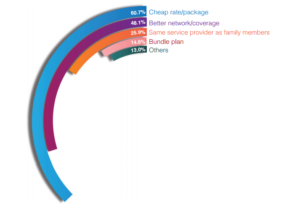
This reiterates the Malaysian Communications and Multimedia Commission’s (MCMC) Hand Phone User 2014 survey where it found 90% of users have stayed with their respective service providers in the first year. Of the 10% that have ported over to another provider, 60.7% share that they have no qualms in changing if competitors were to offer a better package.
On this end, it is increasingly important for MNOs to build and maintain loyalty among subscribers, seeing as switching over to competitors has become easier and more accessible as well.
This is one of the many trends identified by Frost & Sullivan. Its 2016 ICT Outlook for Malaysia telco highlight that the overall mobile subscriber penetration is expected to remain stable, however the churns rates will increase by 2-5% because of intensified competition.
Among the reasons why Malaysians stop or change their subscription is due to poor network or coverage of service providers, a solid indicator that users are a stickler to obtain value for money plans and stable high speed connectivity.
Says MCMC: “Service providers need todeliver (quality) services to gain users’ long term loyalty. In addition, the on-net prices, which tend to be substantially lower, has encouraged 25.9% of users to subscribe to the same serviceprovider.
(Competitor’s) bundled package plan has also attracted 14.6% of the users to change serviceprovider.”
“The lackcustomer experience from telecom service providers is the fourth highest reason for Malaysians to stop their subscription,” adds Frost & Sullivan.
“To maintain the same share of customer wallet, and to drive the data service adoption, service providers are enticing subscriptions by offering unique propositions. For example, Digi is offering mobile internet add-ons for social Apps, while U Mobile offers video streaming services for free.”
High Speed Infra
With mobile internet data and connectivity seemingly climbing up on the ladder of importance, service providers are also continuously improving infrastructure and bringing forth the next generation of connectivity in the form of 4G LTE.
“Users demand for high speed connectivity and they have no qualms ending their subscription from the current service provider due to low speed,” shares Frost & Sullivan.
On the global level, Gartner shares telecom service spending is projected to decline 2% in 2016, with spending reaching US$1.4 trillion. As for mobile data spending, on the other hand, is a bright spot with accelerating growth driven by improved pricing on bandwidth, mobile app and 4G/LTE network availability.
Ericsson’s Ashton believes the current LTE adoption in Malaysia is still very small despite 80% of the country’s population being smartphone users, but the growth of LTE in the country will be a huge revenue growth opportunity for service providers in the coming years.
“Adoption of LTE services will grow at a very fast pace. LTE subscribers is expected toreach close to 10% of the overall subscriber base by 2016,” says Frost & Sullivan.
It is no wonder that providers such as Celcom, Maxis and Digi have been aggressively expanding its coverage within the country, while trying to one up each other in a price war for data. Perhaps another round of our Showdown to see who will win the race?