Back with a Bang!
Gigabyte doesn’t have a local presence in Malaysia so when Vincent Liu, who is the Director for Sales and Marketing Division, called us up for a visit, we decided to get a few comments from him and ask a few questions about Gigabyte’s upcoming products.
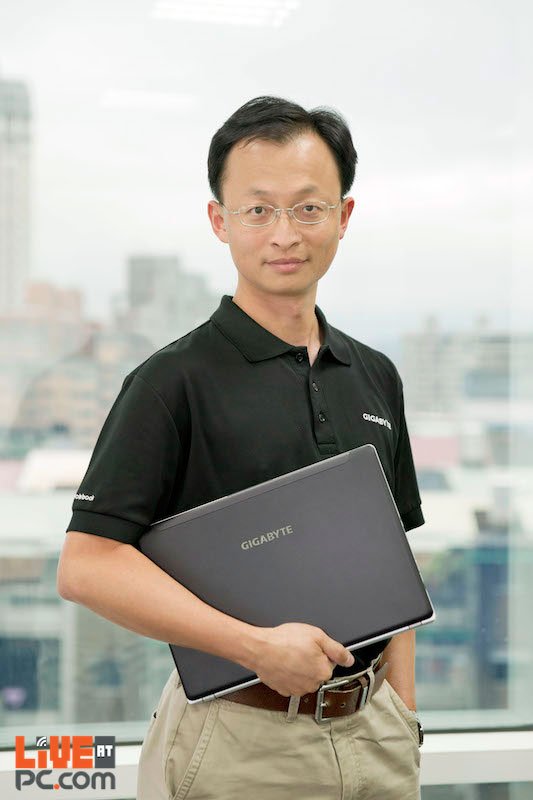
PC.com: Tell us about yourself and your role in Gigabyte.
Vincent: I’m in charge of Gigabyte’s notebook division, including sales and marketing. We’re one of the few brands that produce, design and market our products all by ourselves. And Gigabyte might be the last one that still manufactures in Taiwan, so as to ensure better quality control. Companies used to make their newer factories in China because of the lower labour cost, but now it’s not really cheap anymore. My other responsibility is on the R&D side, in charge of product and purchasing in the R&D side. For instance, the product concept for our AORUS and P series laptops comes from my team. So I’m actually in charge from a very early stage and all the way to the final go-to-market.
PC.com: When you get feedback from consumers, does it get back to the R&D department? How much of it is put to use?
Vincent: Immediately! (laughs) See, Gigabyte as an organisation isn’t too big; we’re not a huge company where divisions only talk to each other once a year. In fact, our R&D and sales team work on the same floor of the same building and we have meetings twice a week. There will be me, our boss Mr. Ma, all the R&D heads and our product managers. For example with our AORUS X5 in the development stage, we’ll meet to talk about product development and maintenance, as well as customer feedbacks. Is there a software or hardware issue? Do we need a new BIOS or a mechanical refresh? So you can see that feedback goes back to the R&D department almost immediately.
PC.com: Do you have to produce new versions of a product quickly?
Vincent: It depends on the situation. If it’s software or something that can be solved on the BIOS level, we release new updates on our website. Our AORUS laptops, for example, have this Smart Update feature that will inform users of new drivers or BIOS. Software issues won’t necessarily bother everyone, except maybe the power users who will try to customise settings and in that case software becomes important. If it’s a hardware issue, then it’s more difficult. Say there’s a mechanical problem, we need to notify the service side and tell them how to solve it. We have to move fast, in order to ensure that our users are responded to quickly. Most of the time the feedback aren’t anything big, but the less we have these discussions the more likely that the small problems could lead to bigger ones. We also take feedback from our Facebook pages and in forums, then respond directly to those channels.
I think, however, that in the end we are not actually able to guarantee that our machines will be 100 per cent problem free. There are always new software and applications that we have to do our best to support, in as short a time as possible.
PC.com: What are Gigabyte’s latest innovations or inventions?
Vincent: Laptop is a main focus of our business, so I’d say any innovations tend to be in that area. For Gigabyte notebooks we have the AORUS gaming notebook series and Gigabyte’s own, two separate brands because of different target market audiences.
PC.com: Tell us about your AUROS laptops.
Vincent: AORUS is targeted at those who are into extreme gaming, who require high-end performance in gaming. On the AORUS, we have the X7 that has dual Nvidia GTX970M, while our X5 will come with a version that has 4K resolution. We’d like to believe that our AORUS laptops are among the best in the gaming notebook industry.
It’s not just performance either, as we’re very proud of our laptops display. We don’t just focus on the max resolution, but also the colour gamut and the refresh rate of the display. For the average person, it’s usually colour and not display resolution that impresses them anyway. Why this is important is, for example, the colour gamut of a conventional laptop is around 45 per cent. That means what you see isn’t how it really looks like, unlike if the display has 100 per cent colour gamut. This is why we try to give us displays the best in not just resolution, but also colour reproduction and high refresh rates.
PC.com: How about your standard Gigabyte laptops?
Vincent: We’re focused on bringing the best in user experience, so there’s also our Gigabyte laptops for general usage. It sticks with elegant designs like in the P34 and P35, which are targeted at people who not just play games but also need a machine for office use. An example would be a college student who loves playing games, but also need a laptop for school work. Many of them are not going to pick something with a tacky design, since it would be embarrassing for them! Or maybe a working adult that wants something for work, while being able to game on as well when the boss is away. (laughs) Just one design and colour that fits the needs of many, perfect.
PC.com: Would you say they are more for casual gaming, then?
Vincent: Oh no, it’s not really just for casual gaming. See, our P34 itself has an Nvidia GTX970M while the P35 comes with a GTX980M. Both also come with Intel Core i7 processors, two SSDs and many more of the top-notch technology.
PC.com: Your 15in AORUS X5 comes with dual GFX cards. Why did Gigabyte choose to do so?
Vincent: Alright, here’s a quick reference: the GTX980M scores 10,000 on 3DMark 11, while the GTX970M SLI scores 14,000 – 40 per cent more – and the AORUS X5 scores 12,000. Clearly, performance being higher is a key reason.
PC.com: What is the difference of having two GPUs instead of one?
Vincent: There are still some people who like having just one GPU like what our Gigabyte notebooks have, because they say that having higher compatibility is better. This applies to people like mechanical engineers or designers, who find that the software or applications they use aren’t as compatible with SLI notebooks. In short, a single GPU notebook can provide better compatibility, but if the user wants greater performance then SLI is the way to go.
PC.com: Do you run into any issues with heat management on such dual-GPU notebooks?
Vincent: Yes, having two GPUs can be very challenging in terms of heat management. The smartest way to go about it is to manage the power draw. There are people who claim that because a laptop is slim, it probably doesn’t perform as well as another with better heat management. Physics are involved, yes, and having bigger space means you can put in a larger heatsink or fans. However, many gamers wear headsets and when a gaming notebook runs on high load, you can bet that the fans are running on the highest speed too. At that point, things get a bit noisy even if some find it acceptable.
To solve that we introduced a Smart Fan that has a different ‘gear’. With this fan, the user can switch between performance and stealth mode. The latter is very useful for those times when the user wants a quieter environment. They can choose the settings for themselves, but we went further to help enhance their user experience. We wanted the application to be able to help a user to judge when it has to change gears. That’s where the ‘Smart’ comes in place – the user doesn’t have to think, he or she just uses the laptop. This is the kind of feature we always try to give to our users.
PC.com: What do you think of the gaming market now? Do you think many have moved to console instead of PC?
Vincent: I believe that both the console and PCs can exists in tandem in the industry. Let’s take the PS2 15 years ago, the graphics performance it has is actually beyond a PC. Consoles were the machines that let us experience the fanciest of visuals in games. But when Nvidia came into the picture with its GTX graphics card, a PC’s GPU easily outperformed consoles. Right now, a dedicated GPU provides users not only with great gaming experiences, but also powers a variety of applications.
There are many types of games and applications out there and for those who want to play casually, consoles are still easier for them to use and still provide decent graphics. However, with PCs you can play the most advance games. The amazing thing is that the graphics in PC games now look so lifelike, it’s like watching movies. Even something as simple as a shadow, which were completely black before and thus don’t look real, now shadows have the proper shade of grey. PC gaming now is like being in a movie and the role of the characters are in your hands. In addition, new technology like Virtual Reality takes this one step further. I’d say there’s more headroom for PC gaming to improve at this point.
PC.com: So currently your flagship is the 17in X7 Pro? When will there be a version with 4K display and are the other parts upgradable?
Vincent: Yes, it is. 4K version… all I can say is “coming soon!” We haven’t set an actual timeline yet, but the outlook is sometime at the end of this year. Unfortunately, I can’t guarantee that. As for upgrades, definitely! The components can be accessed by removing the screws on the back, so most things can be upgraded. Of course, currently the CPU and GPUs have to be soldered on the motherboard so those can’t be changed. But the memory, SSDs and hard drives are changeable.
PC.com: Finishing up, is there anything else you want to say?
Vincent: Thank you very much, to all the Gigabyte fans who have always supported our products!