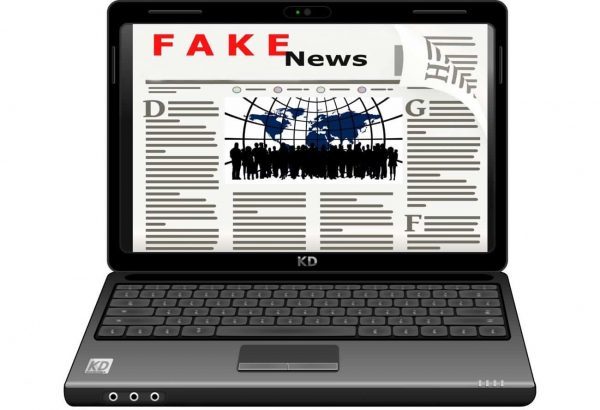
How do you tell apart satirical or made-up news, with honest to goodness news reports? Fake news…who do you trust?
Let’s face it: the way we consume media has drastically changed over the years. Long-form news is now an arbitrary choice, and sensationalistic headlines catch the attention of social media users.
My lecturer once told me that “news isn’t news, if it’s not new”. I’m inclined to believe that what he meant didn’t entail the mass users of social media just reading off headlines, and not the actual article.
With the fast-paced environment we live in now, everyone wants to be in the know; be someone who disseminates information, whether useful or not. It’s like a game of Chinese Whispers: some parts of the information could be skewed or totally and utterly deviated from the original content. This is a world we live in now. A world where fake news are liberally peppered amidst real content, making it harder and harder for the masses to differentiate the two.
So it’s hardly surprising when Oxford Dictionaries Word of the Year 2016 is post-truth. The adjective is defined as relating to or denoting circumstances in which objective facts are less influential in shaping public opinion than appeals to emotional and personal belief.
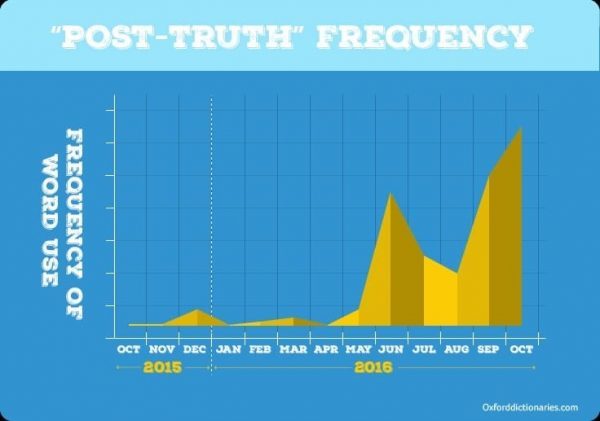
Post-Truth Era
According to Oxford Dictionaries, rather than simply referring to the time after a specified situation or event – as in post-war or post-match – the prefix in post-truth has a meaning more like ‘belonging to a time in which the specified concept has become unimportant or irrelevant’.
“A book, The Post-truth Era, by Ralph Keyes appeared in 2004, and in 2005 American comedian Stephen Colbert popularised an informal word relating to the same concept: truthiness,” it shares. “(Truthiness is) defined by Oxford Dictionaries as ‘the quality of seeming or being felt to be true, even if not necessarily true’.”
This was further cemented during the UK Brexit and more recently, the presidential election in the US. In an analysis by BuzzFeed News, the top-performing fake election news stories on Facebook generated more engagement than the top stories from major US news outlets in the final three months of the US presidential campaign.
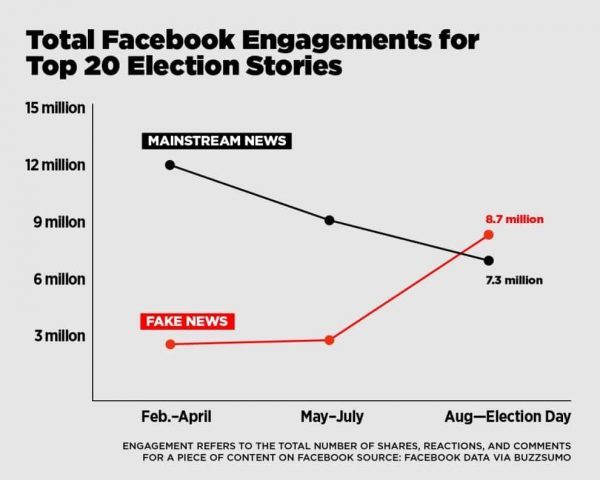
It’s hard to fathom why readers are more captivated with these fake news stories, rather than reading the likes of New York Times, Washington Post, Huffington Post, and NBC News among others.
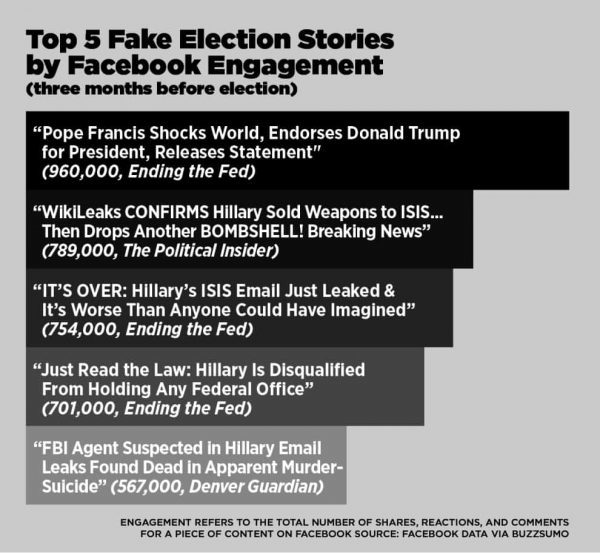
BuzzFeed News also cited that 20 top-performing false election stories originating from hoax sites and hyperpartisan blogs managed to generate more than 8 million shares, reactions and comments on Facebook alone. The number is staggering, and the top 5 fake stories on Facebook are even more unbelievably controversial.
“In this bizarro world, political adversaries resemble comic book villains, a large space rock threatens Earth and one celebrity dies daily as another move(sic) to your town,” says Eric Mack, a CNET contributor in his article: ‘2016 as told by 120 fake news stories.’
Discovering What’s Real
So how do you tell apart what’s real, and what’s utterly rubbish? Snopes believes that “so long as social media allows for the rapid spread of information; manipulative entities will seek to cash in on the rapid spread of misinformation.”
Post US elections, Facebook has come out with a statement to curb the dissemination and sharing of fake new stories.
“The bottomline is: we take misinformation seriously. Our goal is to connect people with the stories they find most meaningful, and we know people want accurate information. We’ve been working on this problem for a long time and we take this responsibility seriously. We’ve made significant progress, but there is more work to be done,” says Mark Zuckerberg, CEO and Co-Founder of Facebook.
“The problems here are complex, both technically and philosophically. We believe in giving people a voice, which means erring on the side of letting people share what they want whenever possible. We need to be careful not to discourage sharing of opinions or to mistakenly restrict accurate content. We do not want to be arbiters of truth ourselves, but instead rely on our community and trusted third parties.”
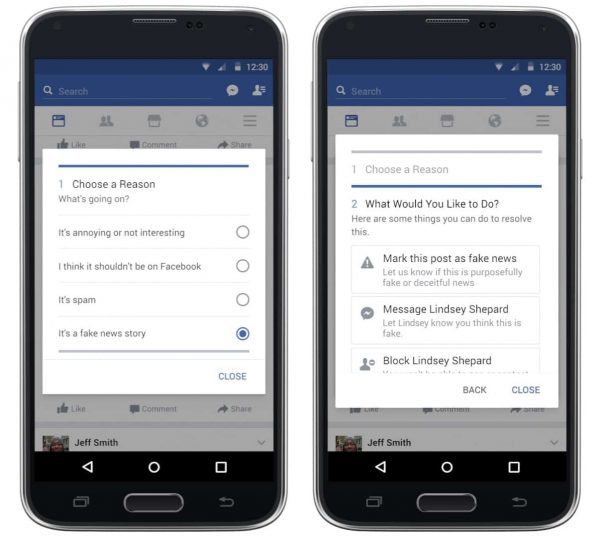
It is currently testing ways to make it easier for its users to report a hoax if they see one on the social media platform. As with many of its reporting and bug fixing efforts, Facebook is encouraging its community to help it on this issue on a bigger scale.
“We have relied on our community to help us understand what is fake and what is not. Anyone on Facebook can report any link as false, and we use signals from those reports along with a number of others — like people sharing links to myth-busting sites such as Snopes — to understand which stories we can confidently classify as misinformation. Similar to clickbait, spam and scams, we penalise this content in News Feed so it’s much less likely to spread,” he adds.
In the statement, Zuckerberg also highlights some of the projects that Facebook is undertaking on this front:
- Stronger detection
Improving its ability to classify misinformation. This means better technical systems to detect what people will flag as false before they do it themselves. - Easy reporting
Making it much easier for people to report stories as fake will help us catch more misinformation faster. - Third party verification
There are many respected fact checking organisations and Facebook has reached out to some to learn. Adam Mosseri, VP, News Feed, Facebook shares: “We believe providing more context can help people decide for themselves what to trust and what to share. We’ve started a programme to work with third-party fact checking organisations that are signatories of Poynter’s International Fact Checking Code of Principles.” - Warnings
It is exploring labelling stories that have been flagged as false by third parties or our community, and showing warnings when people read or share them. - Related articles quality
Facebook is raising the bar for stories that appear in related articles under links in News Feed. - Disrupting fake news economics
A lot of misinformation is driven by financially motivated spam. It is looking into disrupting the economics with ads policies and better ad farm detection. “We’ve found that a lot of fake news is financially motivated. Spammers make money by masquerading as well-known news organisations, and posting hoaxes that get people to visit to their sites, which are often mostly ads. So we’re doing several things to reduce the financial incentives. On the buying side we’ve eliminated the ability to spoof domains, which will reduce the prevalence of sites that pretend to be real publications. On the publisher side, we are analysing publisher sites to detect where policy enforcement actions might be necessary,” says Mosseri. - Listening
It will continue to work with journalists and others in the news industry to get their input, in particular, to better understand their fact checking systems and learn from them.
“Some of these ideas will work well, and some will not. But I want you to know that we have always taken this seriously, we understand how important the issue is for our community and we are committed to getting this right,” Zuckerberg comments at the end of his statement.
In the same vein, tech giant Google is working towards prevent its Google ads from being placed on websites that misrepresent content. It says in a statement: “Moving forward, we will restrict ad serving on pages that misrepresent, misstate, or conceal information about the publisher, the publisher’s content, or the primary purpose of the web property.” It however doesn’t outline its policy change, unlike Facebook.
The Malaysian Story
The move by Facebook is considered timely, given that Malaysia has seen its fair share of fake news stories making its rounds on social media platforms. We even have our local version of satirical news portal, fakemalaysianews.com – our very own The Onion.
According the 2016 Reuters Institute Digital News Report, 69% of Malaysians get their news from social media. Yet a large number of them can’t tell the difference between real and fake news.
Of course, not all hoaxes get disseminated through Facebook. Whatsapp has been a popular choice for propaganda makers. Even local politician Lim Kit Siang agrees that Malaysia is now in an era of fake news, false cartoons and false allegations.
In a blog post, Lim shares that the Penang Chief Minister’s Office had to deny a Whatsapp message on 14 December 2016 with a photograph of the Penang Chief Minister that Lim Guan Eng had supported the action against the Rohingya community in Myanmar.
“The Chief Minister’s special assistant Zaidi Ahmad, lodged a police report on the fake news and said the whole objective of the fake Whatsapp message was a racialist slander to incite religious sentiments against the Chief Minister,” says Lim.
“In actual fact, at the Penang Chief Minister’s initiative, the recent Penang State Assembly unanimously passed a motion condemning the atrocities against the Rohingyas.”
Thus it isn’t surprising that Malaysians are just not careful and gullible in terms of the news they read. Local newspaper reports that the Malaysian Communications and Multimedia Commission (MCMC) held media literacy classes for about 900,000 people this year at 700 1Malaysia Internet Centres (PI1M), showing them examples of fake stories involving MH370, celebrity news and the US presidential election.
It was very shocking to them that most participants can’t tell the difference. Eneng Faridah Iskandar, MCMC advocacy and outreach senior director shares in the same news report: “The (fake) websites are not even as sophisticated as those in the United States, but as long as it reads like something from a newspaper, they can’t tell the difference
“People are beginning to wise up (to fake news) but it can’t happen without a focused education programme. We have a high user and penetration rate, but we are still not media-literate.”
Education will have to start from you – a proactive stance is needed to make sure that you are consuming the right (and real) kind of information and news. Melissa Zimdars, author of ‘False, Misleading, Clickbait-y, and Satirical “News” Sources’ shares her tips on analysing news sources:
- Watch out for websites that end in “.com.co” as they are often fake versions of real news sources
- Watch out if known/reputable news sites are not also reporting on the story. Sometimes lack of coverage is the result of corporate media bias and other factors, but there should typically be more than one source reporting on a topic or event.
- Odd domain names generally equal odd and rarely truthful news.
- Lack of author attribution may, but not always, signify that the news story is suspect and requires verification.
- Check the “About Us” tab on websites or look up the website on Snopes or Wikipedia for more information about the source.
- If the story makes you REALLY ANGRY it’s probably a good idea to keep reading about the topic via other sources to make sure the story you read wasn’t purposefully trying to make you angry (with potentially misleading or false information) in order to generate shares and ad revenue.
- It’s always best to read multiple sources of information to get a variety of viewpoints and media frames. Some sources not yet included in this list (although their practices at times may qualify them for addition), such as The Daily Kos, The Huffington Post, and Fox News, vacillate between providing important, legitimate, problematic, and/or hyperbolic news coverage, requiring readers and viewers to verify and contextualise information with other sources.