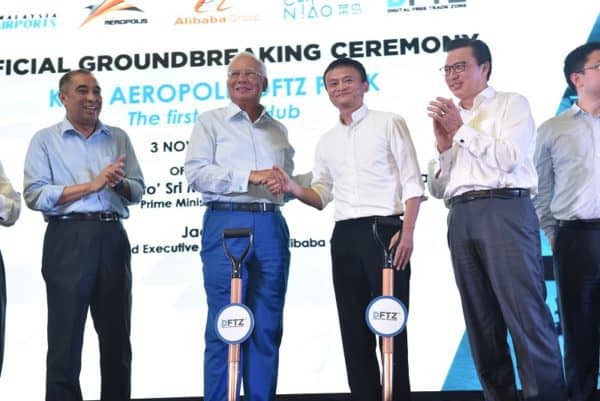
After announcing the setting up of a regional trade zone for eCommerse late last year, Dato’ Sri Mohd Najib Tun Abdul Razak, the Prime Minister of Malaysia together with Jack Ma of Alibaba have now brought-to-life Malaysia’s Digital Free Trade Zone.
A hub meant for small medium enterprise platforms to showcase and market their wares to the global industry via digital platforms supported by various key components DFTZ is the first of its kind in the world. Over 1,900 export-ready sme’s are already on board set to capitalise on the convergence of exponential growth of the internet economy and cross-border trade.
Poignant Role
The Government sees the DFTZ to increase the SMEs goods export to US$38 billion and create over 60,000 jobs and expects support US$65 billion worth of goods moving through the zone by 2025.
Prime Minister Najib added “Back in March, I said Malaysia is set to make it easier for SMEs to do cross-border trade. This is the primary purpose of DFTZ. It is simplifying eCommerce by bringing together government agencies, eMarketplaces, logistic and payment providers all on one platform.
Concurrently, the event also witnessed the launching of KLIA Aeropolis DFTZ Park, Alibaba’s first regional eFulfillment hub outside of China. Malaysia will be a regional hub that will be part of the elWTP which will be connected to the upcoming regional hubs in other continents.
The eFulfillment hub is expected to double the growth in Malaysia’s air cargo volume from the current level of about 700,000 tonnes a year to 1.3 million tonnes a year within ten years. It is equipped with latest technology, including sorting, shelving and pick-pack facilities, Lighting Industrial Units that allow minor repairs and assembly prior to shipping goods.
Seamless Trade
The main objective is to have our local exporters the have the ease of doing business, DFTZ is setup to facilitate seamless cross-border trade and enable local SMEs to export their goods with a priority for eCommerce.
To facilitate this, an eFulfilment Hub will be developed over two phases. The first phase will be at the KACT, refurbished and operated by POS Malaysia to serve Lazada amongst other eCommerce players. The second phase will be a greenfield development over a 60-acre plot to be jointly developed by Malaysia Airports and CAINIAO Network, the logistics arm of Alibaba. This will be operational in 2020.