
October 2017 marks the 10th Anniversary for the Assassin’s Creed franchise. To celebrate this milestone, Ubisoft launched ‘Assassin’s Creed Origins’, a new flagship title that is set in historical ancient Egypt. While it celebrates the Big 10, ‘Origins’ is the 9th main installment for this long running and still expanding game.
‘Origins’ introduces a refreshing new set of gameplay mechanics previously unseen in the franchise. It somewhat mirrors current trends of more RPG-influenced gameplay and levelling systems; Origins even comes with brand-new combat approaches that are similar with its contemporaries, like The Witcher 3 and Dark Souls.
It has been well-received among new players and old fans alike, and is lauded with well-deserved praise. Its success reflects the sales numbers, a statistic that has doubled over its direct predecessor, Assassin’s Creed Syndicate, in the same first 10-days after its market release. All things considered, it is undeniably a great game.
However, with such a big overhaul to its approach, is it still a great Assassin’s Creed game?
Core Gameplay
When the first ‘Assassin’s Creed’ appeared in 2007, it is remarkably notable for a number of new concepts. Among the most critical points are two narrative pillars. First, it offers an intriguing premise that introduces players to the pesudo sci-fi concept of genetic memories being passed through DNA. Second, it plays up to conspiracy theories that reveal how history is crafted through a millennia-old conflict between Assassins and Templars. More importantly, the game weaves the two together with novel and unique gameplay mechanics.
What exactly are these special and signature features that Assassin’s Creed introduced? And how did they, ultimately, differentiate the entire franchise from its peers? And has Assassin’s Creed Origins upheld these game exclusive pillars in its own approach?

Being Socially Stealth-Like
Assassin’s Creed has taught gamers many things. This is includes knowing what to do if you ever need to escape from an aggressive group of guards. Just calm down and discretely sit on a bench and they’ll lose sight of you. If you need to get into a guarded area, simply mix with a group of harmless monks or scholars. Make sure to clasp your hands in prayer just to blend in well. Somehow, the guards will immediately assume you are part of the group and let you pass.
This concept of ‘Social Stealth’ – where you effectively use civilians to evade detection – is something that Assassin’s Creed effectively employs. This function truly sets it apart from other stealth-based franchises. This method goes hand-in-hand with the second Tenet of the Assassin Brotherhood: ‘Hide in plain sight.’
Since the first game, this gaming mechanic became more innovative as it is quickly adopted into subsequent Assassin’s Creed titles. From sitting on benches and blending in with scholars, the repertoire of skills grew beyond what many consider the norm. Skills like hiring courtesans to mask one’s presence or slipping into a sea of people are now in the skill-set. All that works to ensure the Assassin truly disappears.
In Assassin’s Creed Origins
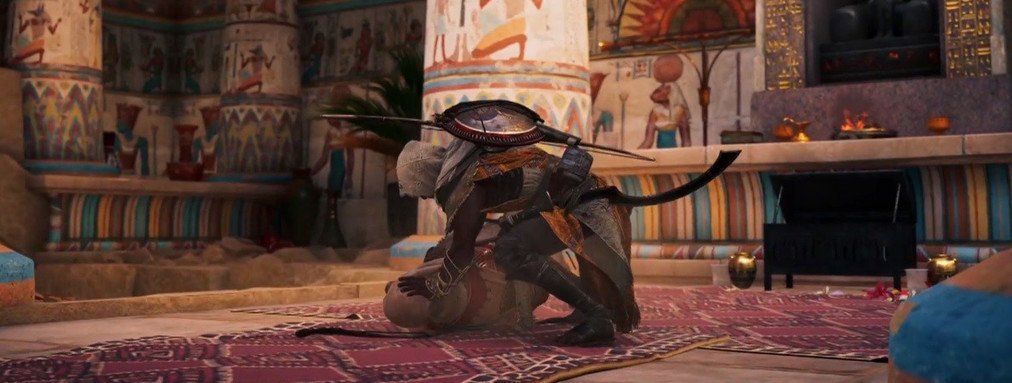
Oddly, ‘Social Stealth’ is completely absent from Assassin’s Creed Origins gameplay. This could be due to a huge portion of ‘Origins’ map featuring mostly sparse landscape and barren deserts. Worse, these areas are peppered with abandoned tombs and mountainous ranges; blending into a sea of people doesn’t seem necessary or likely.
Urban settings in ‘Origins’ are concentrated only in cities and towns, along with outlying settlements. Big, thriving cities such as Memphis and Alexandria, even Cyrene have a significant human population – but not in the staggering numbers of enormous crowds seen in the 2014-released Assassin’s Creed Unity.
However, it’s not so hard to assume Ubisoft wanted to avoid all the performance issues that plagued the launch of Unity. That includes avoiding the risky decision of creating a realistic and dense population within these cities. It does, however, rob the game of prime opportunities to create scenarios for ‘Social Stealth’.
Some fans have cited lore and narrative factors to explain why Social Stealth is not part of Origins’ gameplay. Many theories tie to the fact that this game covers the origins of the Assassin Brotherhood in its primary stages; hence, core tenets and means of operating are not set in stone yet. The main protagonist, Bayek, is also a Medjay, a well-known figure of authority – akin to a town sheriff. In such a role, being able to convincingly hide anonymously in a crowd of civilians seems out-of-place with the character’s background.
However, the absence of a gameplay mechanic that is synonymous with the franchise makes ‘Origins’ stand out from its peers; though not necessarily in a good way.

Parkour Or Bust
Another element unique to the Assassin’s Creed gameplay is using parkour as a primary means of travel. It’s so integrated into the game franchise that it’s now seen as a signature to the series. The protagonist of the first game, Altair ibn La’Ahad, would skilfully leap from roof to roof to reach his objectives. He even uses it as an effective means of escape when needed.
Of course, the parkour mechanics have been improved and refined in subsequent titles. There are also different means of moving around in other instalments, like horse-riding and sailing ships. It is with Assassin’s Creed Unity that parkour is the only means of getting around the game map. In fact, for this game entry, it’s arguably the fastest and most responsive parkour in the series. It is also the first to introduce the ‘controlled descent’ mechanic that allows players to automatically descend from roof-tops safely.

In Assassin’s Creed Origins
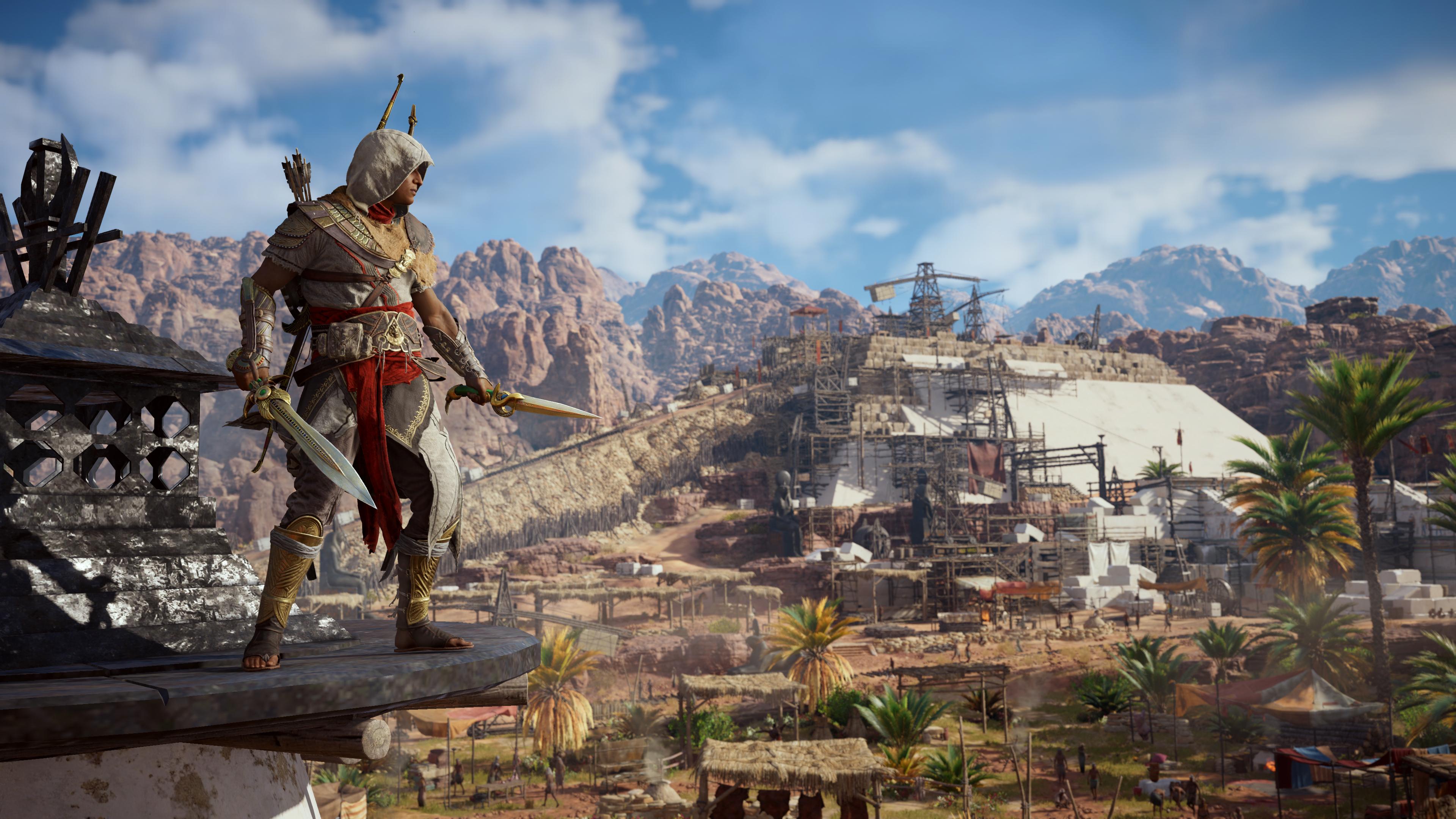
As Assassin’s Creed Origins feature wide vistas and natural landscapes, there no opportunity for Bayek to demonstrate his parkour skills. Instead, the focus on the wide variety of mounts that Bayek can use to get around. From camels to horses and war chariots, even feluccas, he is able to get anywhere in these vehicles.
Urban areas are now in specific zones and have become a mix mess with the barren deserts and mountainous terrain. In between are rich farmlands and lush oases. Thus, there is no reason for Bayek to use parkour to get around.
The only innovation in parkour that Origins introduces is having Bayek be able to climb up almost any surface. This includes rocky terrain, such as cliff faces and outcroppings; these are elements that are not present in previous games that are part of the natural landscapes on the map.
Historical Settings
Another element unique to the Assassin’s Creed series is having its gameplay take place in a historical setting; these elements pair up with overarching Modern Day ‘meta stories’, giving context and reason for players to explore these eras.
Each game introduces a new historical period – from the Crusades, then onto the Renaissance Era, followed with the American Revolution. All these timelines engage players to a visual treat of history; making it their ‘playground’ as they became part of pivotal moments in history while unravelling the protagonist’s story.

In Assassin’s Creed Origins
The historical setting of ancient Egypt is one thing that Origins has gotten absolutely right. In fact, it continues the legacy of its predecessors, drawing players into an exciting time within human history. Effectively, it serves as a ‘time machine’ that takes them to a different era.
Ancient Egypt comes alive in Origins, as players traverse in what is possibly the most accurate reconstruction of Ptolemaic Era. This in comparison to what is being shown on contemporary media to-date. Ubisoft prides itself on the historical accuracy of its Assassin’s Creed games, with its own team of in-house historians serving as proper timeline consultants. Their know-how is necessary to recreate these digital playgrounds and make them as true-to-life as possible.
Origins, within these bustling towns and remote lands, boasts a vibrant and engaging environment. It mostly features NPCs that have their own unique daily routines and professions that populate huge sprawling cities. There are plenty of wildlife around that you can hunt; they can also hunt you for food. And what is an adventure without mysterious mysterious tombs and barren deserts, even fertile green areas and grand imposing temples. All these elements give players a vast and varied playground that they can explore for hours.

How Does Origins Compare?
Overall, how does Assassin’s Creed Origins compare to its predecessors? Is it a worthy instalment to the franchise, the golden child to be worthy as successor? Worse, is it the orphan of the family?
Some long-time fans have stated that Origins’ gameplay approach – especially its trimmed-down, simplistic stealth – have made it foreign somewhat. It’s almost like a distant cousin if in comparison to the rest of the titles in the franchise. Indeed, the name itself implies sneaky, stealthy means of operation and striking silently from the shadows. There is no reference to any straight-up charging in with swords drawn and guns blazing.
Origins Game Director, Ashraf Ismail, shares how Ubisoft is aware that players of Assassin’s Creed have two main approaches when playing these games. Some finish missions with stealth and strategy; others prefer the more straightforward approach of melee combat.
With that in mind, Origins is all about enhancing both play-styles. As it also features RPG elements, players can allocate resources to upgrade their weapons-of-choice – be it swords to bows and spears. The same allocation system is applicable to skills where players can develop either their melee or ranged attack styles. Even stealth skills can gain enhancements.
However, even with these observations, it takes only a few hours into Origins to realise that clear innovations are all about making melee combat more rewarding. As for stealth gameplay elements, they have been reduced to their most basic forms. Indeed, while Origins does offer many opportunities for stealth, there are no incentives for doing so. In fact, Origins might make it feel more punishing for players who take pride in avoiding detection and striking unseen enemies.

The tools that Bayek can use are tragically limited and less versatile compared to previous instalments’ selections. Smoke bombs – once essential for Assassins planning a strategic ambush or retreat – is usable within melee combat only; berserk darts that turn enemies against each other can no longer be deployed as ranged tools.
As for the levelling systems in Origins, the hidden blade is now a weapon that loses its one-hit kill. Enemy captains of higher levels will only suffer little damage from hidden blade attacks, making melee combat unavoidable. That means not being able to sneak around enemy forts and dispose of enemies completely undetected.
All these factors – coupled with various new elements – make it feel as if the stealth player’s experience is now not important in the game’s design. New to Origins and the franchise include the Trial of the Gods events, War Elephants, and Arena gladiator battles. The last one rewards melee players for trying and testing their skills in the coliseum-like stage.
It cannot be denied that Assassin’s Creed Origins is a spectacular and substantial game; one that fully immerses the player in a gorgeous and detailed recreation of Ancient Egypt. Indeed, this writer spent hours wandering the expansive areas within the game and abusing the newly introduced ‘Photo Mode’. Seeing the beautifully-rendered, sprawling vistas from a literal bird’s-eye view of Bayek’s pet eagle, Senu, is nothing short of amazing!
While Origins is indeed an enjoyable game, one cannot help but ponder on a few things. With so much legacy elements from its predecessors missing – would it have been better off being a new IP; in many ways, become unrelated to the Assassin’s Creed franchise? This not many are able to answer at this point and, honestly, no one seems to have any concern for it.
(Text by Cappy Lannoire)