The California based semiconductor company jumps into the VR fray.
AMD has announced in GDC 2015 that it will strive to create the best VR experience for developers and end-users. First on this roadmap is AMD’s LiquidVR Software Development Kit (SDK), which will enable development of VR content using AMD hardware. Additionally, it will be able to assist in comfort and compatibility, in order to move the growing VR industry forward and bring full-fledged VR gaming closer to reality.
An important concept in VR is to give users the feeling that they are ‘in’ the game, immersing them fully, and a key challenge to achieving that is motion-to-photon latency – described as “the time between when a user moves their head and when his or her eye sees an updated image reflecting that new position.” It is critical to minimise this latency in the goal towards truly immersive VR.
To reduce this latency, many processes are involved and with LiquidVR, AMD will be able to tackle the challenges. CEO of Oculus, Brendan Iribe, says that: “We’re excited to have AMD working with us on their part of the latency equation, introducing support for new features like asynchronous timewarp and late latching, and compatibility improvements that ensure that Oculus’ users have a great experience on AMD hardware.”
Raja Koduri, Corporate VP of Visual Computing at AMD, also states that “AMD will continue to collaborate closely with the VR ecosystem to deliver new LiquidVR technologies that aim to make the virtual world every bit as accurate as the real world.”
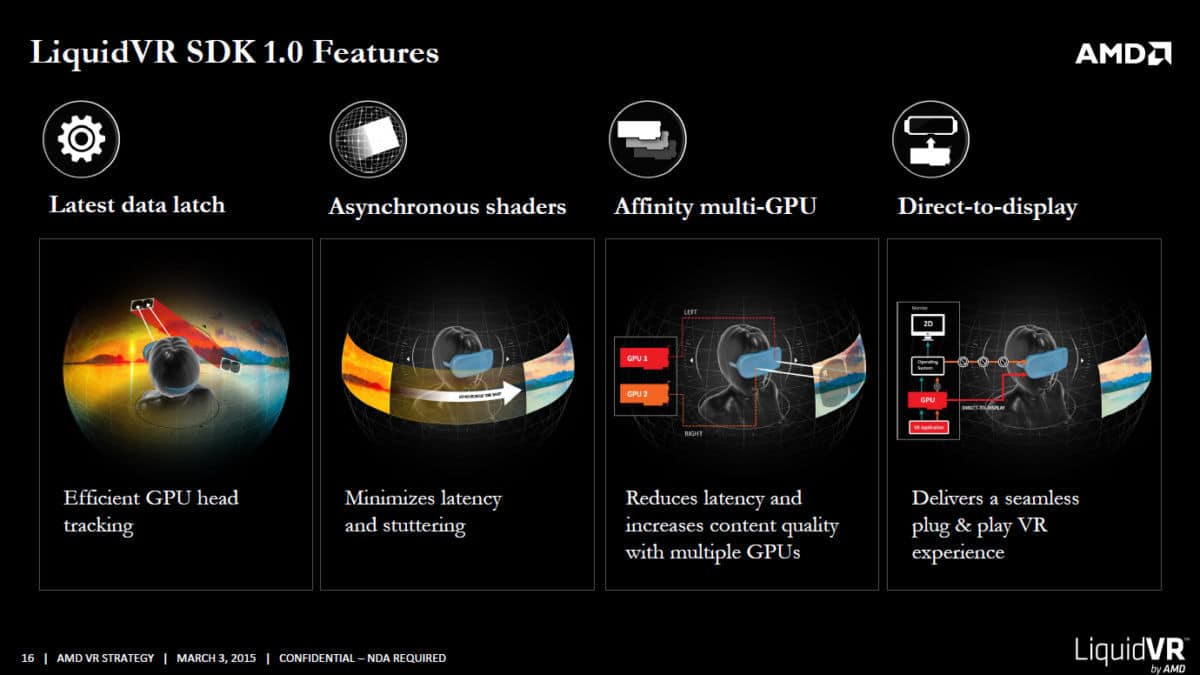
The alpha version of the LiquidVR SDK 1.0 will include features like Async Shaders for smooth head-tracking enabling Hardware-Accelerated Time Warp; affinity Multi-GPU for scalable rendering; latest data latch for smooth head-tracking; and direct-to-display for intuitively attaching VR headsets.
Find out more about LiquidVR at http://www.amd.com/en-us/innovations/software-technologies/technologies-gaming/vr.