TM AND PARTNERS WITNESS THE NEW BAY OF BENGAL GATEWAY CABLE SYSTEM GO LIVE
Set to Provide Business Growth Opportunities in South East Asia, South Asia and the Middle East
Malaysians experienced first hand the inconvenience, when last month Telekom Malaysia had one of its submarine cable Cahaya Malaysia damaged, many were not pleased and there was also a regional online gaming tournament postponed due to the effect. The Pacific link, connecting to Japan and US is prone to regular interruption and not to mention earthquakes and susceptible to disruption to internet connectivity. With digital being integral in every day life and lifeline for operation and business, downtime is becoming less tolerable. Telekom Malaysia agrees and believes better internet days are around the corner, here’s why.
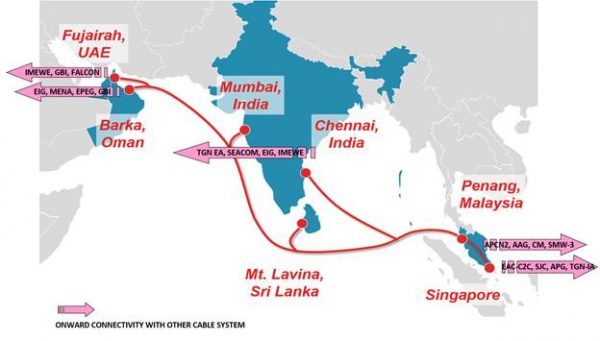
TM together with a consortium of regional telecommunication partners announced the launch of a new Bay of Bengal Gateway (BBG) submarine cable system which links Malaysia and Singapore to Oman and the UAE, with branches to India and Sri Lanka. The BBG cable system which spans 8,100 km has started carrying its commercial traffic on 30 March 2016, the new cable runs through the west as opposed to the current route.
The Consortium, formed back in 2013 for the establishment of the submarine cable system, consists of TM itself together with Dialog Axiata of Sri Lanka, Etisalat of the United Arab Emirates, Omantel of Sultanate of Oman, Reliance JioInfocomm of India and Vodafone of United Kingdom.
Commenting on the landmark milestone, Mohamad Rozaimy Abd Rahman, Executive Vice President, Global & Wholesale, TM said, “The establishment of BBG submarine cable denotes the consortium partners’ utmost commitment in the development of IP communications globally and initiative to extend broadband connectivity to a wider audience. The additional capacity via BBG will help to better prepare and mitigate any potential future congestion we may face. TM, alongside Vodafone Group are very honoured to take the lead in this endeavour and it definitely puts us in good stead moving forward. I believe there will be many other new opportunities that will arise from this newly launched submarine cable.”
Rozaimy added, “The launch of BBG indeed marks yet another commitment from TM in providing faster and resilient Internet connection, hence a better surfing experience for Internet users. In line with being the nation’s leading telecommunications provider, TM continues to play its integral role in fulfilling the Government’s aspiration of the Economic Transformation Programme (ETP) that is “Extending the Regional Network” as this cable system will enable us to provide Malaysians with better regional reach and a highly dependable regional network.”
The cable system will link Malaysia (through Penang) and Singapore to the Middle East (Oman and United Arab Emirates) with connections reaching out to India (Mumbai and Chennai) and Sri Lanka.
It is set to provide an alternative route to Europe for TM’s IP traffic. This diversity is essential especially in the earthquake prone zones in the Pacific Ocean region and will also complement the other cable systems which TM are latched on to. This cable system is a unique one as it rides on TM’s comprehensive protected terrestrial network from Penang, Malaysia to Points-of-Presence (PoPs) in Singapore. This will enhance the reliability of this cable system by avoiding the busy and crowded Malacca Straits and other cable cut prone areas.
This will not only provide connectivity between South East Asia, South Asia and the Middle East, but also to Europe and Africa through interconnections with other existing and newly built cable systems landing in India and the Middle East. BBG will also open up vast opportunities for business growth as it will support current and future high capacity requirements from the surrounding areas of the region as well as next generation Internet applications. The markets are expected to see strong growth with the continuous efforts in embracing the broadband technologies and infrastructure expansion.
It is also designed to provide upgradable and transmission facilities by adopting the state-of-the-art 100Gbps technology.
TM owns or leases capacity in 20 submarine cable systems (including those under construction), which span more than 200,000 fiber-route miles around the globe, including several submarine cable routes that the company uses to carry traffic between Asia-Pacific region and North American region.