Want an awesome sound system, but find yourself struggling in cable management? With Bang & Olufsen’s new wireless speaker, you can get good audio without having to tuck lengths of cable away. The all-digital active speakers leverage the new WiSA standard for multi-channel wireless sound to provide acoustic performance beyond anything you have heard without cables.
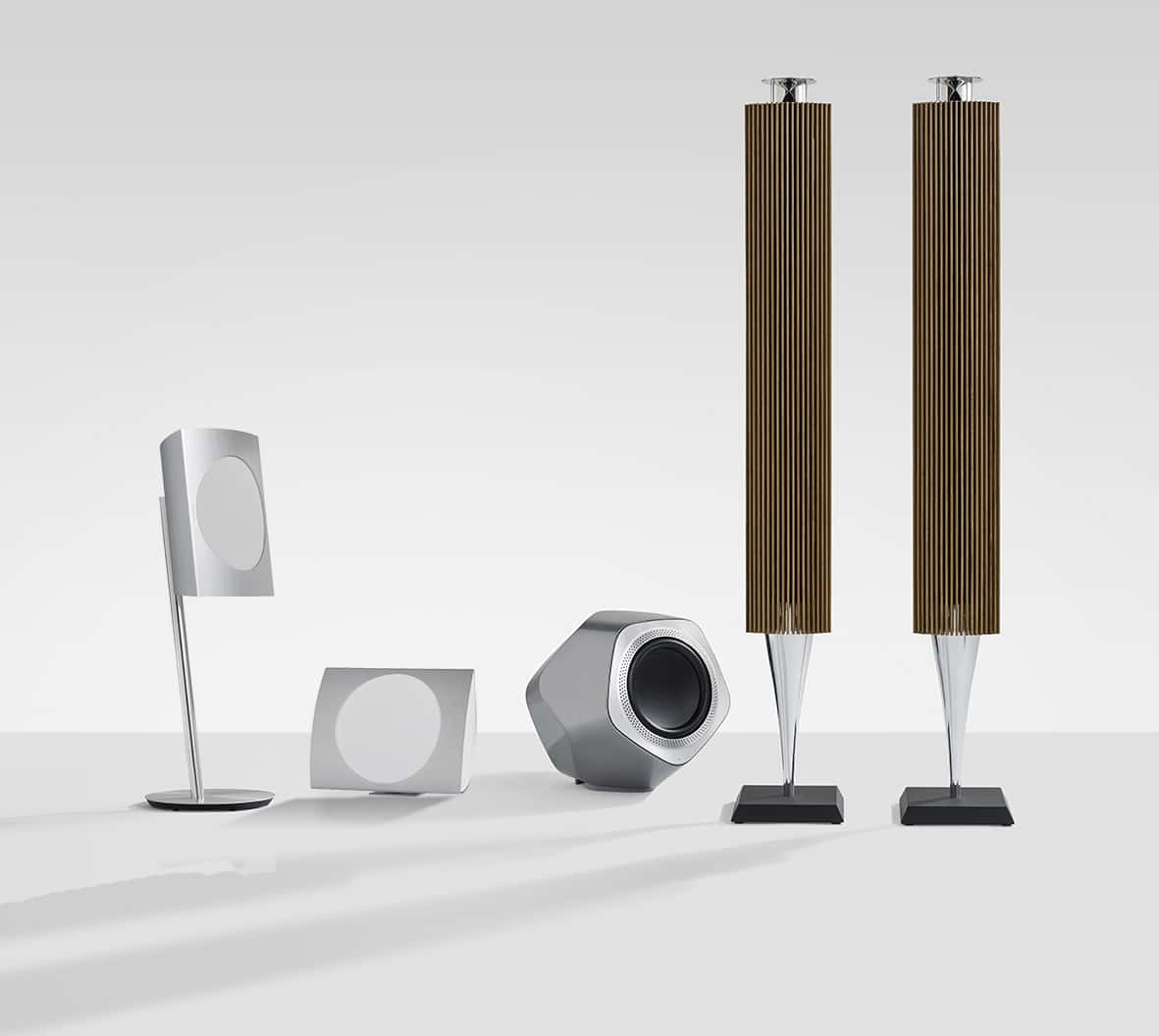
The new range consists of three products – the BeoLab 17, 18 and 19. The BeoLab 17 is a compact speaker; the BeoLab 18 is the latest incarnation of Bang & Olufsen’s sculpturally iconic audio columns for walls or floor; and the BeoLab 19 is a radically redesigned subwoofer. All three run on the new WiSA standard. All the user needs to do is plug the active speakers into the mains in a room with any WiSA-compliant transmitter in order to link wirelessly to their TV, Blu-ray player or set-top box.
The two-way BeoLab 17 packs a custom-made 6” midrange/woofer, a ¾” tweeter, a pair of 160-watt class D amplifiers and a proprietary digital sound engine. With more than 40 times the processing power of analogue circuitry, the new digital sound engine is the brain behind the brawn that makes big sound possible in such a small package.
The Beolab 18 builds upon the success of Bang & Olufsen’s iconic column speakers, reaching into the future with all-new components, a re-engineered digital sound engine, an enticingly tweaked form factor and something as classic – and modern – as Nordic hardwood.Two custom-made 4-inch midrange/woofer drivers run in parallel and are powered by separate 160-watt class D amplifiers. The digital sound engine is custom-tuned to deliver convincing performance that brilliantly overcomes the complexities presented by placing the lamella in front of the two main drivers.
The all-digital BeoLab 19 packs two custom-made 8” drivers, each paired with its own dedicated 160-watt class D amplifier, are placed back to back in separate enclosures to minimize interaction.
WiSA, short for “Wireless Speaker and Sound Association”, utilizes the relatively uncongested 5.2–5.8 GHz range to avoid interference from other signals, and to provide enough bandwidth to stream 24-bit, uncompressed music at native sampling rates. It is also the first wireless system in the U-NII band that provides multi-channel performance – up to a full 7.1 surround configuration.