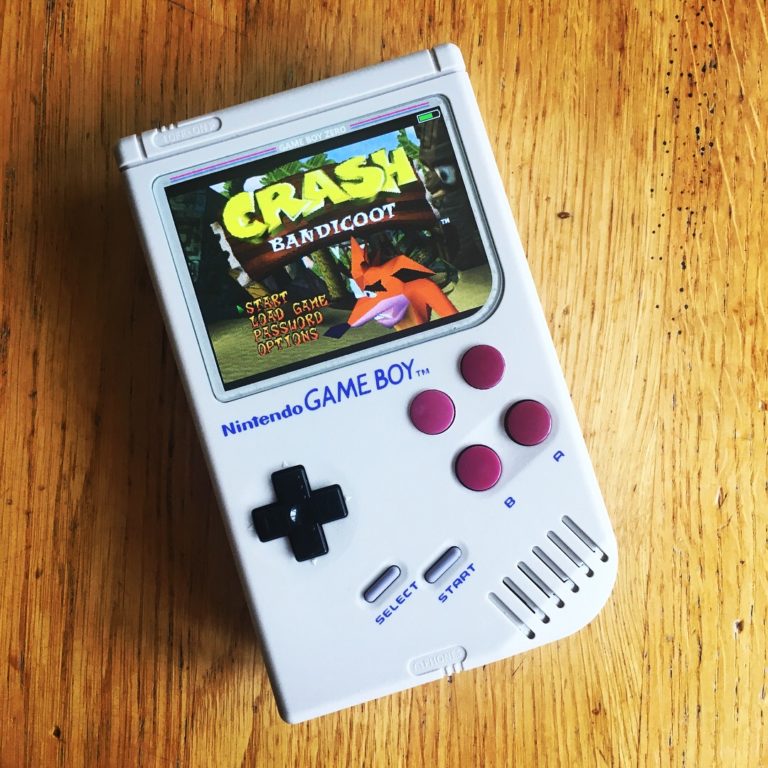
If you’re born in the 80’s or 90’s, you should know about Nintendo’s first handheld game console, the Game Boy. It was one of the most successful consoles that dominated the market from 1990 to the early 2000s. Just like how you recognize an aspirin for Panadol and toothpaste for Colgate, the same applies for any handheld consoles. If you don’t know what a Game Boy is, don’t worry. You’ve come to the right place.
Here is a story for you on how Nintendo came up with the Game Boy. In 1979, the game designer for Nintendo, Gunpei Yokoi, was in a bullet train. He noticed a bored businessman playing with a calculator by hitting random buttons. It was at this moment, Yokoi had a brilliant idea to come up with Game & Watch, the predecessor to the first ever Game Boy.

In April 1989, the first Game Boy was launched alongside Super Mario Land, Alleyway and Baseball. It had a monochromatic LCD display and a serial port. The port allows connection of up to 16 other Game Boys using an adapter. There’s a slot behind the console to house the game cartridges. This was the beginning of time for many to blow into their cartridges if their games don’t load. The original Game Boy went through several design revisions. The first design revision is the “Play It Loud!” design which has different colour choices for the original Game Boy as well as a clear case. Several improvements were made to the original Game Boy along the way giving birth to what was known then as the Game Boy Pocket.
As the name suggests, the Pocket version is smaller and lighter. It only required 2 AAA batteries compared to its predecessor that needed 4 AA batteries and a DC jack to power the console. The screen featured a true black-and-white display and an LED power due to public demand. Initially, the Pocket came in one colour before introducing different colours 2 years after the launch back in 1996.
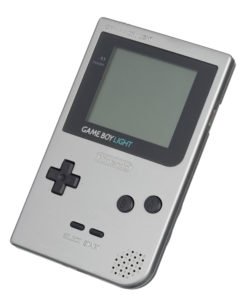
An electroluminescent front-light was later introduced in the Game Boy Light when playing in low light conditions, hence the naming scheme. A pair of AA batteries powers the console. It lasts as long as 20 hours without the light on and 12 hours when it is switched on. Unfortunately, the Light was only sold in Japan in either silver or gold.

Nintendo later introduced the successor, the Game Boy Color, featuring a colour screen in 1998. New games such as Tetris DX, Mario Land 2 and Pocket Bomberman were launched together with the console. The console is backward compatible with games from the first generation Game Boy. You are not wrong if you think Nintendo name their handheld consoles relevant to the upgrades they made. In addition to that, the Color in Game Boy Color actually has colours to show the different colour choices available for the console.

Finally, the third generation Game Boy made its debut in 2001. The Game Boy Advance had a major change in design. The buttons were relocated to the sides of the screen instead of the common practice of placing it under the screen. Furthermore, the serial port in the Game Boy Advance could support Game Link cable for connecting to other Game Boy consoles and GameCube link cable to connect to GameCube. In 2003, Game Boy Advance SP, foldable version of the Game Boy Advance was introduced. It has a rechargeable lithium ion battery, an LCD screen with a back light with a switch to turn it on or off and the original button layout for Game Boy.

The final version of the Game Boy Advance was introduced in 2005 which adopted the design cue from the first ever Game Boy Advance, the Game Boy Micro. As you would have expected by now, the Game Boy Micro is smaller and sleeker. Unfortunately, the Micro isn’t as backward compatible as its other siblings from the same generation. It doesn’t support games from the first Game Boy and Game Boy Color generations.
Nintendo’s Game Boy line was available for close to two decades, from 1989 to 2010. It was a major hit and one of the most memorable childhood memory for the 80’s and 90’s generation. Games like Mario, Pokemon, Donkey Kong and Legend of Zelda were famous (still is) back then and everyone would want to get their hands on it. The Game Boy consoles are collectibles that are rare to find these days and needs to be treasured.